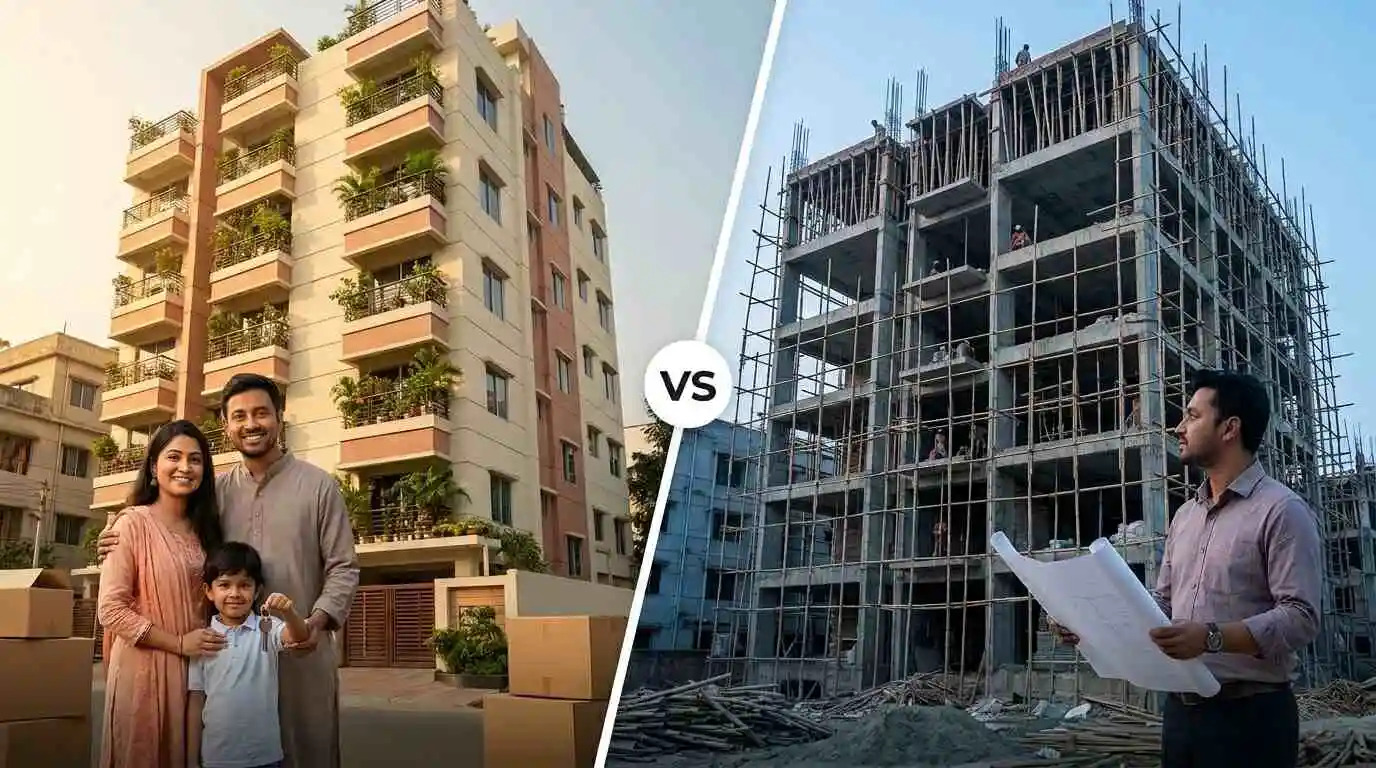
When choosing between a ready flat vs. an under-construction flat in Dhaka, a ready flat is better for immediate move-in, instant rental income, and full inspection. An under-construction flat suits those seeking lower initial prices, installment plans, and layout options.
Your best option depends on your timeline, cash flow, and risk tolerance. Partnering with a trusted real estate company in Bangladesh guarantees clear legal papers, verified approvals, and reliable delivery.
Navigating Dhaka’s real estate market means balancing immediate housing needs with long-term financial growth. Whether it's about escaping rent or spreading costs over time, choosing the right home requires weighing upfront costs against handover timelines.
Below is a quick decision framework to help you make the right choice.
The quick answer
Choose a ready flat if you need a home soon, want to see exactly what you buy, or want rent coming in right away.
Choose an under-construction flat if you can wait, prefer to pay in installments, and have checked the developer well.
Both work for the right buyer, and both go wrong when buyers skip the checks.
Answer three questions to find your side.
- When do you need the home? If your lease ends soon or your family must move this year, lean ready.
- How does your money come in? A large sum in hand signals readiness. Steady monthly income points to installments.
- How much delay can you absorb? If a late handover would mean you have to pay rent and installments together for a long time, lean ready. If you can wait without stress, an under-construction flat can work.
Two or three answers on one side settle it. Mixed answers?
Read the cost of waiting section below and run your own numbers.
What are a ready flat, an under-construction flat, and a near-handover flat?
A ready flat is a finished apartment you can visit, inspect, and move into soon after you pay and register.
An under-construction flat is sold while the building is still going up, so you buy from plans and a written promise.
A near-handover flat sits in the middle, with the structure up and the developer finishing the interiors and common areas.
The word "ready" is used loosely. Some sellers use it for buildings that are still awaiting utility connections or final paperwork.
Heads Up. Ask for proof that the building is complete. Then check that the lift, power backup, water, gas, and electricity really work before you call any flat ready.
The near-handover flat is the middle path.
You still wait, but not for long, and you can often see the real floor, the walls, and the neighborhood. Its price and risk usually fall between the other two, though each project is different.
Ready vs under-construction flat: side-by-side comparison
The table below puts the two options side by side on the points that matter most.
Use it as a checklist when you talk to any developer.
| Point | Ready flat | Under-construction flat |
| Price at purchase | Usually higher | Usually lower at booking |
| How you pay | Large payment in a short time | Installments spread over the build |
| Move-in time | Soon after payment and registration | After the handover, on the date in your agreement |
| What you can inspect | The real flat | Plans, a sample flat, and the site |
| Handover delay risk | None for the flat itself | Real, and it depends on the developer |
| Choice of floor, facing, and layout | Only what is left | Widest choice for early buyers |
| Say in finishes | Little or none | Sometimes, if you ask early |
| Home loan | Bank values a finished flat | Money is often released in stages |
| Registration | Can move quickly once papers are clean | Agreement first, sale deed usually later |
| Rental income | Can start right away | Starts only after handover |
| Possible value growth | Already in the price | May rise by handover, but not guaranteed |
| Resale or exit | Easier, because buyers can see it | Harder, so check the transfer rules in your agreement |
| Service charge | Usually starts once you own or occupy | Usually starts at handover, so confirm in writing |
Benefits of buying a ready flat
The benefits of buying a ready flat come down to certainty. You see the home, you get the keys soon, and no construction delay can hold you back.
For many families, that peace is worth the higher price.
You see exactly what you get
Stand in the living room. Open the windows. Notice where the sun falls and whether air moves through the rooms. A brochure cannot show you any of this. With a ready flat, you can assess the light, ventilation, room size, and finishes with your own eyes, and bring an engineer or a trusted relative along.
You move in or rent it out right away
You stop paying rent on your old place sooner. If you are buying to earn, a tenant can move in without a long wait. Under-construction buyers pay for months or years before the first rent check arrives.
No handover delay risk
The building is already standing, so no late project can delay your move-in date. That matters most for families with school dates, job moves, or a lease that is about to end. You still need to check the papers, but the biggest fear of an under-construction buyer is gone.
Registration can happen quickly
Once you pay in full and the documents check out, registration does not need to wait for any construction stage. Speed still depends on clean paperwork. A fast sale with weak documents is worse than a slow sale with strong ones.
Banks can value a finished flat, so loans are usually simpler
A bank can inspect and value a completed flat in one step. Under-construction loans tend to be released in stages instead. Every bank sets its own rules, so ask yours for the exact terms in writing.
Downsides of a ready flat
A ready flat costs more upfront and offers fewer choices. That is the trade for certainty.
The ready flat price in Dhaka is usually higher than the booking price of a similar flat in a building that is still going up. It also asks for a big payment in a short time.
If you want to compare real numbers for a PDL Real Estate home, ask the team for a written price sheet via the quote page, so you can weigh the ready-flat price in Dhaka against the installment plan on the same terms.
Other downsides are smaller but real. The best floors and views may be gone. You cannot change the layout or the fittings. You live with whatever the developer chose.
Older-ready flats add one more cost: age. Wiring, plumbing, and fittings wear out, and repair bills can surprise a buyer who only looked at the sale price.
"Ready" does not mean "legally clean." A finished building can still have weak land papers, a mortgage, or missing approvals.
Always verify all property registration documents using the checklist below before you pay.
Benefits of buying an under-construction flat
Buying an under-construction flat in Bangladesh gives you a lower starting price, easier payments, and more choice. You pay for these gains with patience and some risk. The next sections show how to keep that risk small.
Lower price at booking
Developers usually price early units below finished ones. The gap pays you for waiting and for carrying the risk. Compare the total cost, not only the rate per square foot, because parking and other charges can change the picture.
Installments spread the cost
You pay in steps as the building rises, so you do not need the whole amount at once. That helps salaried families who build savings month by month. Tie every installment to a real construction stage, not to a calendar date the developer controls.
Best pick of floor, facing, and layout
Early buyers choose first. If you want a south-facing flat, a higher floor, or a corner unit, booking early gives you the best shot at it.
Some say it finishes
Some developers let early buyers pick tiles, fittings, or small layout changes before that work begins. Ask what is allowed, and get every approved change in writing.
Value may grow by handover
A flat bought early in a growing area may be worth more when the building is done. That is a possibility, not a promise. Markets move both ways, so never stretch your budget in the hope of a price jump.
Risks of an under-construction flat
The risks of buying an under-construction flat are real, but most of them shrink when you check the developer and the agreement before you pay a single taka.
Handover delays
A flat handover delay is the risk buyers fear most. Delays can stem from financial issues, approval delays, contractor changes, or rising material costs.
PDL Real Estate ties payments to construction milestones and tracks progress through milestone audits, which is the kind of discipline you should look for when weighing a flat handover delay risk with any developer.
The finished flat may not match the brochure
You buy from plans and a sample flat. The real unit can differ in light, view, or finish. Ask for a written specification that names the materials and brands, so "premium quality" means something you can check.
Extra payment demands at handover
Some buyers face new charges at the end that they never planned for. Ask for a full written list of every charge before you sign, including parking, utility connections, and deposits.
Registration delays
Ownership moves to you only when the sale deed is registered. Ask the developer when that will happen and put the timeline in your agreement.
The project could stall
A stalled project is the worst case. Check how many projects the developer has finished, and look for any that stopped midway.
Past delivery is the best clue to future delivery.
Costs beyond the price tag
The price in the brochure is not the full bill.
Both ready and under-construction buyers pay extra on top of it.
Plan for these items.
- Registration cost, including stamp duty and registration fee
- VAT and gain tax where they apply
- Local government and land development charges
- Utility connections for electricity, gas, and water
- Parking, if it is sold separately
- Service charge once you move in
- Finishing and furniture for a bare flat
Rates change often, so this guide does not quote specific figures. Following the government cuts to registration taxes announced in the FY2025-26 budget, earlier tax estimates may no longer reflect current rates.
Navigating the flat registration process in Bangladesh requires checking current government fees at the local sub-registrar's office to avoid surprises.
Accounting for the hidden costs of buying a home, such as utility connection fees, gain taxes, and parking allocations, is essential before finalizing any housing budget.
Additionally, long-term ownership entails ongoing expenses, including the property tax in Bangladesh once the title transfer and possession are complete.
Pro Tip: Ask the developer for a single written sheet listing the flat price, parking, all government charges, and all handover charges. Then compare the two projects by their final totals.
The real cost: paying rent while you wait
If you rent today, every month of waiting has a price. The simple formula shows when a cheaper under-construction flat no longer offers value.
The price gap divided by the monthly rent equals the break-even delay in months.
Here is an example with round numbers. These are not market figures, so swap on your own.
Say the ready flat costs Tk 10,00,000 more than the under-construction flat, and you pay Tk 40,000 rent each month. Tk 10,00,000 divided by Tk 40,000 gives 25 months.
If you wait longer than 25 months, the cheaper flat ends up costing you more.
Now see what happens when the handover is late. Assume the building was promised in 24 months.
| Handover | Months of waiting | Rent paid while waiting | Price gap saved minus rent paid |
| On time | 24 | Tk 9,60,000 | Tk 40,000 saved |
| 12 months late | 36 | Tk 14,40,000 | Tk 4,40,000 lost |
| 24 months late | 48 | Tk 19,20,000 | Tk 9,20,000 lost |
One year of delay turns a small win into a clear loss. The table is also kind to the under-construction side, because it ignores one thing.
A ready flat needs more cash early, and that cash could earn interest or cost you loan charges. If you own another home and pay no rent, the math changes again, so run it with your own numbers.
Remember. The cheaper flat is only cheaper if it arrives on time.
Home loans: ready vs under-construction
Banks look at a ready flat as a finished asset. They value it once and can release the loan in one step. An under-construction flat is different because banks often release money in stages as the building rises.
That staged release can leave you with both rent and installment payments. Banks and finance companies set their own rules, so ask your lender for terms in writing before you book either type.
Reviewing our first-time home buyer's guide to down payments, interest rates, and financing steps will help you evaluate these options with confidence.
Next Step: Get your in-principle loan approval before you choose a flat. It tells you your real budget and keeps you from falling for a price you cannot finance.
What the law says about the handover being late
If a developer delays the handover, the law gives you a refund path, and the agreement you sign shapes that path.
According to Section 15 of the Real Estate Development and Management Act, 2010, published on the Bangladesh government's laws portal, a developer who fails to deliver within the agreed time must refund the total money paid, along with the compensation set in the agreement. The refund is issued as an account payee cheque within six months.
If you and the developer agree to extend the date through a supplementary agreement, you get compensation under the same section. When your agreement specifies no rate, the Act sets the compensation at 15 percent of the total amount paid.
In that case, the developer may pay the money and compensation in up to three installments within six months. If talks fail, either side can take the matter to arbitration under the Arbitration Act, 2001.
Here is the practical side. Legal cases take time, and time is the one thing a late buyer does not have. The developer you choose protects you more than any law can, so invest your effort there.
This section is general information and not legal advice, so ask a lawyer how it applies to your own agreement.
How to check a developer before you pay
Check the builder as hard as you check the flat. Five checks do most of the work.
- Delivered projects. Visit finished buildings and talk to the owners. Ask whether the flats arrived on time and whether the specification matched the promise.
- RAJUK approval. Request the approved building plan for your specific project. A missing plan is a red flag.
- REHAB membership. Check that the developer is an active member in the member directory at rehab-bd.org. REHAB and RAJUK are two separate checks, and you need both.
- Stalled projects. Ask if any of the developers' projects stopped midway, and why.
- Financial strength. Look at the group behind the developer and its record of finishing what it starts.
If you are buying an under-construction flat in Bangladesh, you can run these same checks on PDL Real Estate, a sister concern of the PRAN-RFL Group that has built homes since 1983.
You can go through completed, ongoing, and upcoming projects and visit them in person.
You can easily know PDL's construction process of how a build moves from plan to handover.
Document and agreement checklist
Papers protect you when memory and promises fail. Check these before you pay, whether the flat is ready or not.
Documents
- Land title and the ownership history
- Mutation (Namjari) records that show the current owner
- The approved building plan
- Power of attorney, if the seller is not the titled owner
- Mortgage or bank loan status on the land and the project
Your agreement
- A delay penalty with a clear amount or rate
- Refund terms if you or the developer cancel
- A specification annex that names materials and brands
- Parking details
- Your share of the land
- Handover conditions and the handover date
Important. Sign a registered agreement, not only a booking form. A booking form gives you very little protection if something goes wrong.
Have a property lawyer read the papers before you pay. The fee is small next to the cost of a dispute.
Inspection checklists
A good inspection takes an afternoon and can save you lakhs of taka.
Ready flat
- Damp patches on walls, ceilings, and bathrooms
- Quality of the finishing, tiles, doors, and windows
- Fittings, switches, taps, and fixtures
- Gas, electricity, and water connections that work
- The monthly service charge and what it covers
- The age of the building and its repair history
Under-construction flat
- Regular site visits to see real progress
- Dated progress photos from the developer
- Registration papers ready before the handover date
- A building management plan for after handover
Pro Tip. Take photos of the site on every visit and keep them with your agreement. Compare them with the developer's progress reports.
Which one should you choose?
Match your situation to the table, then confirm with the checklists above.
| Your situation | Better fit | Why |
| You must move soon | Ready flat | No wait and no delay risk |
| You pay rent and cannot afford a delay | Ready flat | Delay would double your housing cost |
| You earn each month steadily and can wait | Under-construction flat | Installments suit your cash flow |
| You want to rent it out quickly | Ready flat | Rent can start right away |
| You want the best floor and facing | Under-construction flat | Early buyers choose first |
| You live abroad and cannot visit often | Ready flat | Less to monitor from far away |
| You plan for long-term growth in a developing area | Under-construction flat, with a strong developer | Know more about Jolshiri Abashon and its growth |
Which gives a better return?
Neither option guarantees a better return. A ready flat can earn rent from the first month. An under-construction flat may rise in value by handover, but it earns nothing while you wait, and a delay can wipe out the gain.
Your result depends on the area, the developer, the price you paid, and how long you hold; thoroughly evaluating the yields, hidden costs, and market risks of real estate investment in Bangladesh will give you a realistic picture of your long-term returns.
Final Verdict
Ultimately, the right choice depends on your timeline, financial flexibility, and risk tolerance:
- Pick a ready flat when certainty, immediate move-in speed, instant rental yield, and a chance to inspect the physical space matter most.
- Pick an under-construction flat when you can wait, prefer flexible milestone-based payment steps, and the developer passes every verification check.
Whichever path fits your situation best, make sure to run the rent break-even math, thoroughly review the registered agreement, and compare the final all-inclusive costs before making a commitment.
Ready to Find Your Dream Home?
Looking for more insights like this one?
Browse our blog posts for expert guides to homeownership in Bangladesh.
If you want to weigh the benefits of buying a ready flat against the risks of buying an under-construction flat for a PDL Real Estate property, request a quote today and ask our team to provide a transparent side-by-side cost and terms comparison in writing.
Frequently asked questions
Is an under-construction flat cheaper than a ready flat?
Often, yes, at booking, because developers price early units lower. The total cost can still end up close once you add rent during the wait, parking, and handover charges. Compare the final total, not only the rate per square foot.
Can I get a home loan for an under-construction flat in Bangladesh?
Often yes, but the terms differ by bank. Lenders usually release the money in stages as the building progresses, so you may pay rent and installments together for a while. Ask your bank for its policy on your exact project before you book.
What happens if the developer delays handover?
Section 15 of the Real Estate Development and Management Act, 2010 requires the developer to refund the money paid, plus the compensation named in your agreement, within six months. If your agreement states no rate, the Act sets it at 15 percent of the total amount paid. Check your delay clause before you sign, because it sets your rights.
When is an under-construction flat registered in my name?
In most deals, you first sign a registered agreement for sale. The sale deed that moves ownership to you is usually registered when the building is ready, and your payments are complete. Your agreement sets the exact timing, so read that clause closely.
Is it safe to buy an under-construction flat?
It can be, when the developer, the approvals, and the agreement all pass your checks. It is risky to pay on a booking form alone or to skip the RAJUK and REHAB checks. Visit finished projects and talk to owners first.
Which is better for NRB buyers?
A ready flat is easier to arrange from abroad because there is nothing left to worry about. If you choose under-construction, appoint a trusted person with a power of attorney, ask a lawyer in Bangladesh to verify the papers, and pay only into the developer's official company account.
Which gives a better return on investment?
A ready flat gives rent now. An under-construction flat may gain value by the time of handover, but nothing is guaranteed, and a delay eats into any gain. The better return belongs to the buyer who picks a reliable developer and a growing area.
What documents should I check?
Check the land title, mutation records, the approved building plan, mortgage status, and power of attorney if one is used. Then read the sale agreement for the delay penalty, refund terms, specifications, parking, land share, and handover conditions.
What hidden costs apply?
Expect registration costs, taxes, utility connections, parking, service charges, and finishing. Rates change, so ask for a written breakdown for your exact flat before you pay.
Can I switch from installments to a bank loan later?
Sometimes. It depends on your bank and your developer's rules. Ask both before you book, and get the answer in writing.