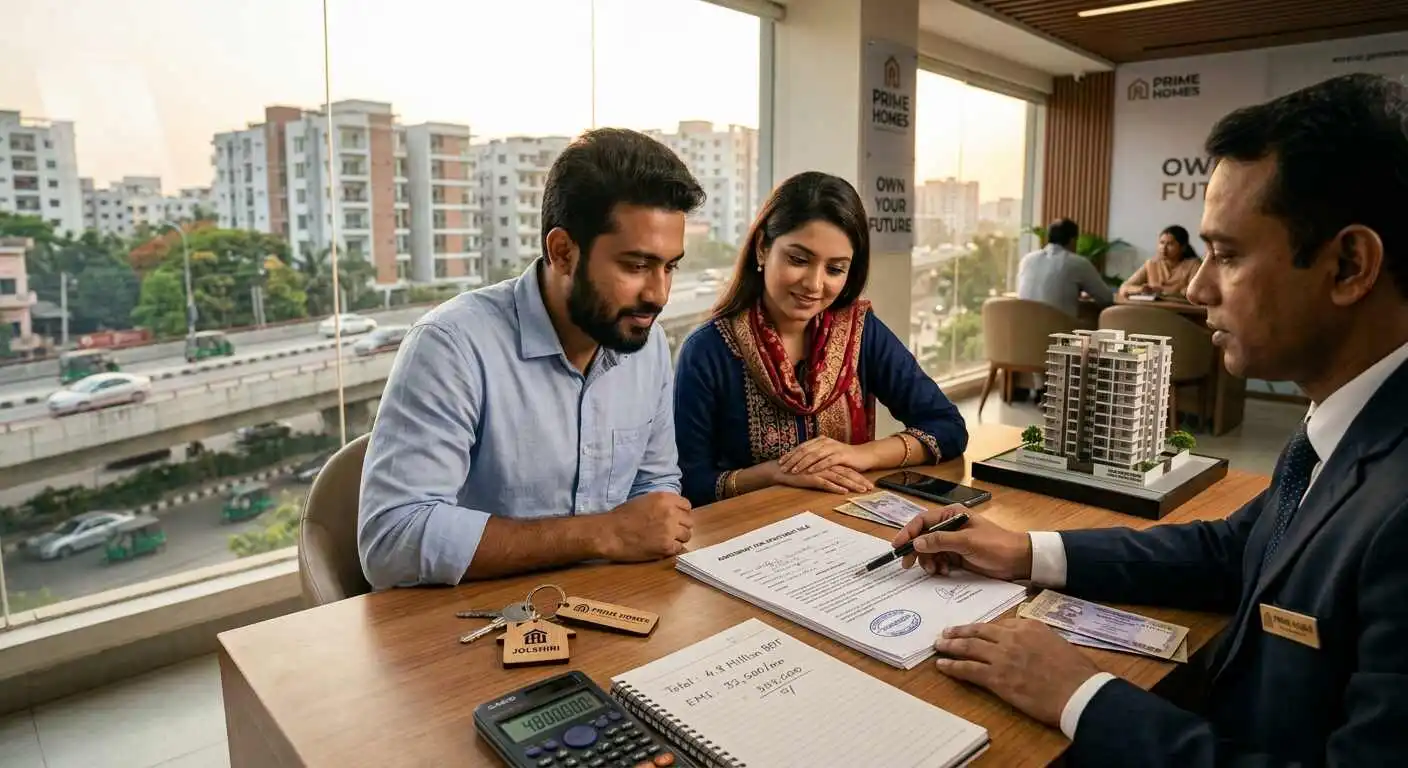
Buying your first home is probably the biggest financial decision you will ever make. It is exciting. It can also be genuinely stressful, especially when you are not sure what the process actually looks like in Bangladesh.
This First-Time Homebuyer's Guide is for anyone starting from scratch. It covers your real budget (including the costs most buyers forget), how home loans work in Bangladesh, which legal documents to check and why, how much registration actually costs, and what separates a trustworthy developer from one that causes problems down the road. All figures are verified for 2025 and 2026. Use them to plan with clarity, not just enthusiasm.
Step 1: Set a Realistic Budget, Including the Hidden Costs
Most first-time buyers start with the flat price. That is the wrong starting point.
The actual cost of buying a flat in Bangladesh is always higher than the number the developer shows you. Before you shortlist any property, add up everything:
- Base flat price: the headline figure from the developer
- Registration, stamp duty, and taxes: for a residential flat inside Dhaka city, this runs roughly 8 to 10% of the flat price (covered in detail in Step 7)
- VAT on the flat: 2% for flats up to 1,600 sqft; 4.5% for flats above that
- Interior setup and furnishing: typically Tk 5 to 20 lakh depending on size and what you bring in
- Utility connection fees: electricity meter, gas meter, water connection combined can be Tk 50,000 to Tk 2,00,000
- Monthly maintenance charges: budget Tk 1,500 to Tk 5,000 per month from day one
- Parking: often sold separately at Tk 3 to 10 lakh; confirm with the developer whether it is included in the quoted price
After adding these up, keep an additional 10 to 15% buffer on top. Unexpected costs are normal, whether that is a delayed utility connection, last-minute interior changes, or moving logistics. Planning for them upfront is how buyers avoid financial pressure in the months after handover.
If you want a thorough breakdown of where money quietly disappears in a property purchase, the article on the hidden costs of buying a home is worth reading before you finalize your number.
Step 2: Understand Home Loans in Bangladesh (With Real Numbers)
Most people buying their first flat in Bangladesh cannot pay the full price upfront. A home loan is not a last resort. It is the standard route, and it is worth understanding properly before you approach any bank.
The Bangladesh Bank 70:30 Rule
Bangladesh Bank sets a loan-to-value (LTV) limit for all home loans. Banks can lend a maximum of 70% of the property value. You must bring the remaining 30% yourself as a down payment.
Some non-bank financial institutions (NBFIs) allow up to 80% LTV, which means a 20% down payment, but they typically charge higher interest rates in exchange.
To put this in practical terms: on a flat priced at Tk 1 crore, the minimum down payment through a standard bank is Tk 30 lakh.
Current Home Loan Interest Rates (2025 to 2026)
| Lender Type | Rate Range | Notes |
|---|---|---|
| BHBFC (state-owned) | 7% to 9% | Lowest rates; competitive eligibility requirements |
| Private banks (BRAC, Prime, Dutch-Bangla) | 9% to 12% | Flexible terms; faster processing |
| NBFIs (DBH Finance, IDLC) | 13% to 14.5% | Higher LTV possible; higher rate |
Most banks offer loan tenures of 20 to 25 years. Salaried professionals with at least two years of stable employment history get the best terms. Self-employed buyers should expect more documentation requests and sometimes a lower LTV offer.
One thing worth asking about: Bangladesh Bank operates a subsidized refinance scheme where eligible first-time buyers can access rates around 5% through select banks. Ask your bank directly whether you qualify before assuming the standard rate applies.
Compare at least three lenders before committing. The difference between 9.5% and 12% over 20 years is a very large number, even if the monthly EMI difference looks modest.
Step 3: Choose the Right Location
Location affects your daily quality of life and your long-term financial return. A well-built flat in the wrong location can still be a poor decision. Experienced buyers evaluate a few things before committing to an area:
- Commute time to your regular workplace, not just distance on a map but actual travel time in Dhaka traffic
- Proximity to schools, hospitals, and markets within a practical daily radius
- Road connectivity, especially expressway or flyover access, which matters enormously in this city
- Security and the quality of the surrounding community
- Planned infrastructure nearby, which directly affects price appreciation over the years you hold the property
Residential Areas Worth Considering in 2026
Jolshiri Abashon (Rupganj, Narayanganj) has become one of the most in-demand planned residential townships near Dhaka. It is adjacent to Bashundhara R/A, connected directly to the 300 Feet Expressway and Kuril flyover, and was developed under Bangladesh Army supervision, which means proper zoning, maintained road networks, and consistent infrastructure. Current apartment prices range from roughly Tk 8,000 to Tk 12,000 per sqft. The most common configuration is a 4-bedroom unit of around 2,850 sqft, priced between Tk 2.5 crore and Tk 3.5 crore depending on the developer, floor, and facing.
Aftabnagar, Dhaka is an established mid-city option with solid connectivity to Rampura and Badda. It suits buyers who want to stay close to central Dhaka.
Bashundhara R/A is a premium township with well-maintained infrastructure. Prices are higher, typically Tk 9,500 to Tk 12,000 per sqft, but the location justifies that range for many buyers.
The article on why location matters in real estate explains the connection between location, lifestyle, and long-term value in more depth. And if you are curious about how Dhaka's residential market is developing beyond the traditional areas, the rise of modern residential hubs covers that well.
Step 4: Vet the Developer Before You Pay Anything
This is the step most first-time buyers underweight. In Bangladesh's real estate market, the developer you choose matters as much as the flat itself. Good developers deliver on time, with full documentation, and stand behind their product after handover. Not all of them do.
Two checks are non-negotiable before you pay a booking amount.
Check 1: REHAB Membership
REHAB (Real Estate and Housing Association of Bangladesh) is the only officially recognized trade body for private developers in the country. As of 2024, it has around 891 active members. Government rules now require REHAB registration for developers operating in Bangladesh.
Verify active membership at rehab-bd.org using the member directory. Also ask the developer directly for their REHAB membership certificate. A legitimate developer produces this immediately. Hesitation is a red flag.
Check 2: RAJUK Approval for the Specific Project
REHAB membership tells you the developer is a registered entity. RAJUK approval tells you the specific building is legally constructed. These are two separate checks. One does not replace the other.
Every residential project in Dhaka requires approval from RAJUK (Rajdhani Unnayan Kartripakkha), which covers the approved building plan, structural design, and utility clearances. An unapproved structure can be demolished by the government, cannot be financed by a bank, and cannot be resold cleanly.
Ask for the RAJUK-approved building plan before you sign anything. A developer who delays providing this document is telling you something.
Other Things to Verify
- RJSC incorporation certificate: confirms the company is legally registered as a business
- Completed project track record: visit past projects if possible, or speak directly with existing residents about their experience
- Delivery history: did past projects hand over on or near the promised date?
- Bank loan approval for the project: if a reputable bank has approved the project for home loan lending, it signals legal compliance
Common red flags: verbal delivery promises with no written penalty clause, inability to produce RAJUK documents on request, no milestone-linked payment schedule, and sales pressure to pay a booking amount before you have reviewed any paperwork.
For perspective on what transparency in a real estate transaction actually looks like, the article on transparency in real estate is a useful reference.
Step 5: Check Construction Quality In Person
A well-built flat holds its value and stays low-maintenance for years. A poorly built one becomes an ongoing financial and practical problem. When you visit a project, look beyond the showroom.
Earthquake resistance: Bangladesh sits in a seismic zone. Ask whether the structural design conforms to BNBC (Bangladesh National Building Code) seismic standards. A responsible developer answers this question clearly and in writing.
Soil test report: proper developers conduct soil testing before construction begins and document the results. You can ask to see the report. If it does not exist, that is worth noting.
Fire safety: look for fire exits, fire-fighting equipment, and evidence that the project has obtained Fire Service and Civil Defence clearance.
Ventilation and natural light: walk through the actual unit, not just the show flat. Poor airflow is something you will live with every day.
Fittings and fixtures: ask for the specification list in writing, with brand names. "Premium quality" in a brochure means nothing unless the sale agreement names the actual products.
Common area quality: lifts, generator capacity, parking, water storage, and building security systems all affect daily life and monthly maintenance costs.
If you want to understand how construction choices affect long-term costs for buyers, the article on hidden costs of cheap construction breaks this down in practical terms.
Step 6: Review Legal Documents Before You Sign Anything
This is the step where first-time buyers most often move too fast. Do not.
Property disputes in Bangladesh frequently trace back to incomplete or unverified legal paperwork. The cost of hiring a property lawyer to review your documents is small compared to the cost of a dispute after you have paid.
Here are the documents you need to check, by name:
Land Ownership Documents
- Title Deed (Saaf Kabala): confirms the seller or developer legally owns the land and has the right to transfer it
- Mother Deed / Bia Deed: the ownership history going back at least 25 years; gaps in this chain are a serious concern
- Khatian and Porcha: government land survey records confirming boundaries and registered ownership
- Mutation Certificate (DCR / Namjari): confirms the current owner's name is recorded in official land records
- Land Tax Clearance: confirms no outstanding government dues on the property
Project and Regulatory Documents
- RAJUK Approved Building Plan: required under the Apartments Ownership Act 1972 and the Real Estate Development and Management Act (REDMA) 2010
- Environmental clearance where applicable to the project
- Power of Attorney if the person you are dealing with is not the primary titled owner
Your Sale Agreement
The Agreement for Sale (Biana) is the most consequential document in this process. Before you sign, confirm it includes:
- A specific handover date with a written penalty clause for delay
- An itemized specification list that names actual materials and brands
- A payment schedule tied to construction milestones, not calendar dates the developer controls
- Clear terms for what happens if you need to exit the agreement
If anything in these documents is vague or absent, ask for it in writing before paying. A confident developer does not object to this. For a checklist of what documents to gather and when, the property registration documents article covers the full list.
Step 7: Know the Full Cost of Flat Registration in Bangladesh
Registration at the Sub-Registrar's office is what makes your ownership legally official. Most first-time buyers underestimate what this costs.
Here is a verified breakdown for a residential flat inside Dhaka city in 2025 to 2026:
| Cost Component | Rate | On a Tk 50 lakh flat |
|---|---|---|
| Stamp Duty | 4% (Dhaka residential) | Tk 2,00,000 |
| Registration Fee | 1% | Tk 50,000 |
| VAT (new flat up to 1,600 sqft) | 2% | Tk 1,00,000 |
| VAT (new flat above 1,600 sqft) | 4.5% | Tk 2,25,000 |
| City Corporation Tax | 2% | Tk 1,00,000 |
| Mutation and miscellaneous | Fixed | Tk 10,000 to 15,000 |
| Estimated total | 8 to 10% of flat price | Tk 4.6 to 5.7 lakh |
Outside Dhaka city, stamp duty drops to 3% for residential property, which lowers the total somewhat.
After registration, complete the mutation (Namjari) step as soon as possible. This updates the government land records with your name as the new owner. Skipping it leaves a gap in your legal standing that can create problems if you ever sell or need to prove ownership.
For a full step-by-step walkthrough of the paperwork and process, the flat registration process in Bangladesh article covers everything in order. If you want to understand the ongoing property taxes after you own the flat, the property tax in Bangladesh post covers what to expect each year.
Step 8: Make On-Time Delivery a Contractual Requirement
Project delays are one of the most financially painful problems in Bangladesh real estate. When a developer runs 12 to 18 months late, you end up paying rent and EMI at the same time. That is real money, often lakhs of taka, added to what you have already committed.
Good intentions from a developer mean nothing without written protection for you. Your Agreement for Sale must include a penalty clause that requires the developer to compensate you if they miss the handover date. Without that clause, you have no financial recourse for a delay.
Beyond the agreement itself, look for evidence that the developer has actually delivered on time before. Ask for a list of completed projects, then find out whether those projects handed over near the promised date. Milestone-linked payment schedules are a good sign as well because they mean you pay as construction progresses, not at dates the developer sets unilaterally. Pre-secured material supply is another indicator that a developer plans properly rather than improvising.
PDL Real Estate was built around this specific commitment to buyers. Backed by PRAN-RFL Group, one of Bangladesh's largest industrial conglomerates, and a founding member of REHAB, PDL tracks construction progress through milestone audits and pre-secures materials before each construction phase begins. For buyers who have dealt with delayed projects elsewhere, that track record is worth verifying directly. The article on on-time project delivery in real estate explains how this commitment works in practice, and the PDL promise covers what buyers can expect across the full project lifecycle.
Frequently Asked Questions
How much down payment is required for a home loan in Bangladesh?
Bangladesh Bank rules require a minimum 30% down payment when borrowing from a bank. Banks can lend up to 70% of the property value. Some non-bank financial institutions allow up to 80% LTV, meaning a 20% down payment, but at higher interest rates. Self-employed borrowers and NRBs typically face stricter terms. On a Tk 1 crore flat, the minimum down payment through most banks is Tk 30 lakh.
What documents should I check before buying a flat in Bangladesh?
The essential ones are the Title Deed (Saaf Kabala), Mother Deed or Bia Deed, Khatian, Mutation Certificate, Land Tax Clearance, and the RAJUK Approved Building Plan. Review your Agreement for Sale carefully before signing, paying particular attention to the handover date, the penalty clause, and the specification list. If the developer cannot produce the RAJUK building plan when asked, do not proceed.
How much does flat registration cost in Bangladesh?
For a residential flat inside Dhaka city, total registration charges (stamp duty, registration fee, VAT, city corporation tax, and mutation) add up to roughly 8 to 10% of the flat price. On a Tk 50 lakh flat, budget around Tk 4.5 to Tk 5.7 lakh. Outside Dhaka, the total is slightly lower because stamp duty drops from 4% to 3% for residential property.
How do I verify a developer's REHAB membership?
Go to rehab-bd.org and search the member directory by company name. Confirm the membership is currently active, not just historically listed. Also ask the developer directly for their REHAB membership certificate. Always cross-check this with RAJUK building plan verification for your specific project. REHAB and RAJUK are separate checks, and both are necessary.
What is the current home loan interest rate in Bangladesh?
As of 2025 to 2026, home loan interest rates run from about 7 to 9% at state-owned BHBFC, to 9 to 12% at private banks, to 13 to 14.5% at non-bank financial institutions. Your actual rate depends on the lender, your income profile, and the loan tenure. Bangladesh Bank also runs a subsidized refinance scheme where eligible first-time buyers can access rates around 5% at select banks.
How do I check if a flat project has RAJUK approval?
Ask the developer for the approved building plan and building permit. These documents should be available immediately upon request. You can also verify at the RAJUK office directly or through their EPMS platform online. If the developer can only provide photocopies and is unable to arrange independent verification, treat that as a caution.
What to Do Next
You have now covered the full First-Time Homebuyer's Guide. Most buyers who avoid costly mistakes are not the ones who spent the most money. They are the ones who understood the process before they sat across from a developer.
If you are considering a flat in Jolshiri Abashon, Aftabnagar, or nearby areas, PDL Real Estate offers RAJUK-approved projects with publicly documented timelines and full buyer transparency. Before you visit, the article on how PDL creates communities gives a clear picture of what goes into planning and building these neighbourhoods, from site selection through to long-term maintenance.
Take the time to verify everything this guide has covered. The paperwork is not the exciting part of buying a flat, but it is what protects everything else.