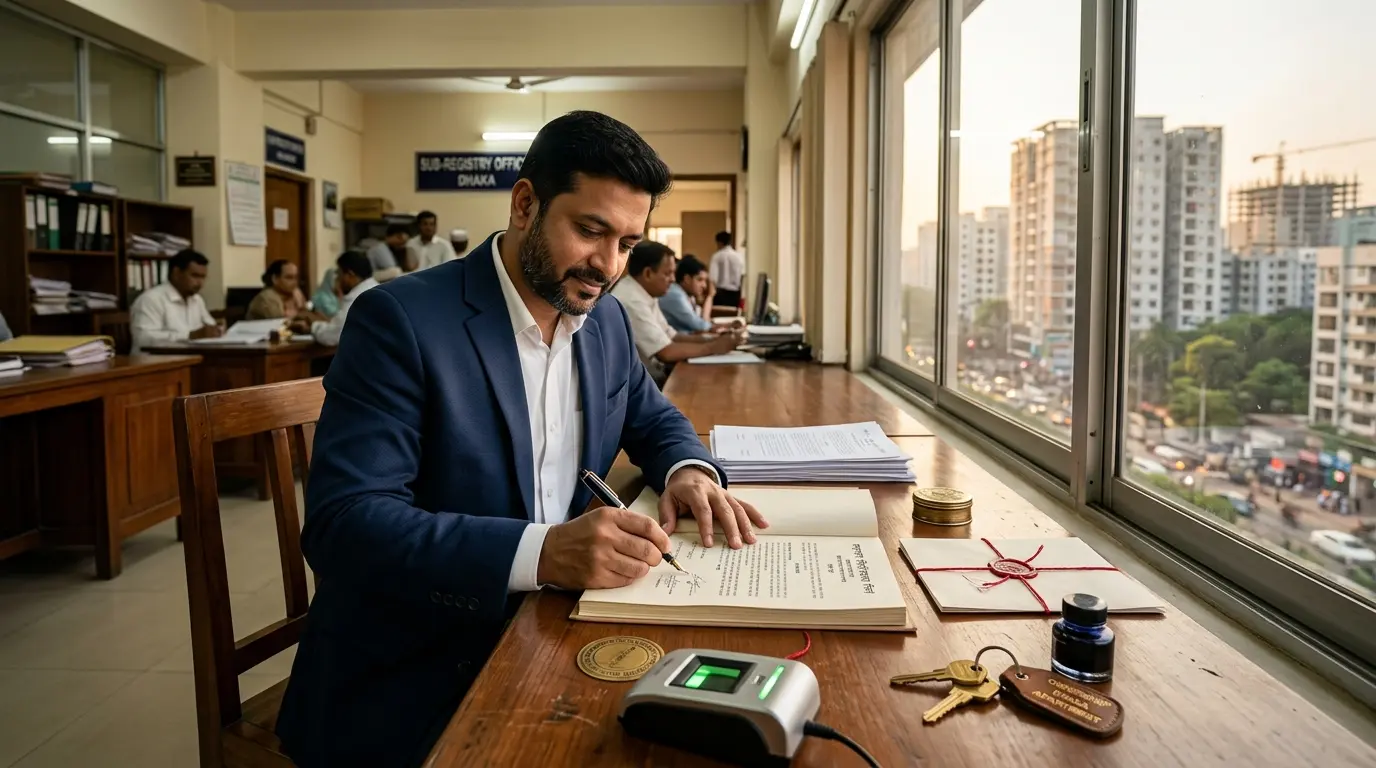
The flat registration process in Bangladesh is a legally mandatory step that converts a property purchase into a court-recognized ownership right. Without a registered deed, your apartment has zero legal standing in any court in the country. The 2026 amendments to the Registration Act introduced mandatory e-registration, biometric NID verification at the Sub-Registry Office, and revised stamp duty rates. Let’s cover every step of apartment registration in Dhaka, from document preparation and RAJUK approvals to e-mutation and title security. Whether you are a first-time buyer or an NRB investor, you will know exactly what to do, what to pay, and which mistakes can cost you your title.
The Legal Framework: Why Registration is Non-Negotiable
The flat registration process in Bangladesh is governed by the Registration Act, 1908, which makes the registration of all transfers of immovable property a legal obligation rather than a choice. An unregistered deed gives you no enforceable ownership claim, regardless of the price you paid or the agreement you signed.
The Registration Act, 1908 (Amended 2026) and E-Registration
The Registration Act, 1908, is the primary statute governing property deed registration in Bangladesh.
The 2026 update, issued by the Ministry of Land, introduced an e-registration requirement mandating that deed documents be uploaded to the government registry portal before the physical visit to the Sub-Registry Office.
This change has reduced paperwork errors, made fee tracking transparent, and shortened processing times for buyers across Dhaka and other major cities.
All parties now receive a digital acknowledgment before the in-person appointment, which removes significant uncertainty from the process.
The Risk of the "Unregistered Deed": Why It Holds No Legal Validity in Court
An unregistered deed, even when signed by both the buyer and the seller before witnesses, carries absolutely no legal weight in Bangladeshi courts.
Under Section 49 of the Registration Act, an unregistered document cannot be used as evidence to prove a property transfer has taken place.
Any court claim based solely on an unregistered agreement will be dismissed outright, as it fails to comply with the foundational Property registration laws Bangladesh mandates for real estate assets. The only way to secure your title to the property and protect your investment is to complete the flat registration process in Bangladesh in full at the Sub-Registry Office.
Mandatory Document Checklist: Beyond the Basics
Preparing your documents correctly before your Sub-Registry Office appointment is the single most important thing you can do. Missing even one item causes delays or outright cancellation of your registration. The flat registration process in Bangladesh requires both standard documents and several commonly overlooked items that even experienced buyers miss on their first attempt.
The "Chain of Title" (Bia Dolil): Tracing Ownership History
The Bia Dolil is the complete chain of prior ownership deeds, dating back to the original khatian or government land allocation. The document chain proves that the seller legally owns what they are selling to you.
Every transfer in the chain must have been registered at the Sub-Registry Office. A gap in the chain is a serious red flag that must be resolved by a property lawyer before you proceed. Buyers should request the following as part of the Bia Dolil:
- Original sale deed of the developer from the original landowner
- All intermediate transfer deeds in chronological order
- Certified khatian and Dag copies from the AC Land office
- Non-Encumbrance Certificate (NEC) from the Sub-Registry Office
Digital Prerequisites: NID Biometric Requirements and TIN Certificates
Since 2023, the Bangladesh Sub-Registry system has required biometric NID verification for both buyer and seller at the time of deed execution.
Both parties must appear with their original National Identity Cards for fingerprint scanning. Both the buyer and seller must also provide valid TIN certificates, which can be obtained through the National Board of Revenue portal.
Without these digital prerequisites, the registration officer is not authorized to proceed under current regulations.
Technical Approvals: RAJUK/CDA Building Plan Compliance
Before completing apartment registration in Dhaka, you must verify that the building holds a valid approved plan from RAJUK or the relevant development authority.
The approved plan number must appear inside the sale deed. If a building plan was never approved or has since expired, the registration may still proceed, but the title can be legally challenged later.
Always request the Building Construction Permission (BCP) document from your developer before signing any purchase agreement. Reputable developers make this available upfront.
The 6-Step Registration Process
The flat registration process in Bangladesh follows a clear six-phase sequence in 2026. Each phase must be completed in order, and skipping or rushing any step increases the risk of a defective title that can be challenged in court years after you move in.
Phase 1: Forensic Due Diligence (Title Search and NEC)
Start with a title search at the Sub-Registry Office, covering at least the last 25 years of the property's ownership history.
Request a Non-Encumbrance Certificate (NEC), which officially confirms that no mortgage, lien, or legal dispute is currently attached to the flat or the land beneath it.
The search takes 3 to 5 working days and costs a nominal fee at the registry office. Working with a developer that has a long history and clear documentation makes this phase considerably faster and less stressful.
Phase 2: E-Fee Calculation and Treasury Challan Settlement
Use the online fee calculator to determine the exact flat registration fee in Bangladesh, including the applicable stamp duty, registration fee, and local government tax based on your property's location and declared value.
Once calculated, you must pay through a treasury challan at a designated bank, most commonly Sonali Bank or another government-linked bank connected to the iBAS system.
Keep the original challan receipt safe as you will need it at the registry office, and it becomes a permanent part of your deed file.
Phase 3: Deed Drafting (Saf Kabala) and E-Registration Portal Upload
A licensed deed writer or property lawyer must draft the Saf Kabala, which is the standard form of sale deed in Bangladesh.
The deed must include the full property description, the declared consideration amount, the RAJUK approval number, the NID numbers of all parties, and the TINs of both the buyer and the seller.
Once drafted, the deed must be uploaded through the Sub-Registrar's e-registration portal at least one working day before the scheduled appointment. This upload requirement was introduced in 2026 and cannot be bypassed under any circumstances.
Phase 4: The Sub-Registry Office Visit: Biometrics and Execution
Both the buyer and seller, along with at least two adult witnesses, must appear at the Sub-Registry Office on the scheduled date with all original documents.
The registration officer will compare the uploaded deed against the originals. Biometric fingerprint scans of all parties are recorded in the government system.
The officer then executes the deed by signing and affixing the official seal. This phase typically takes between 30 minutes and 2 hours depending on the daily queue at the specific office.
Phase 5: Securing the Section 52 Receipt
After the deed is executed, the Sub-Registry Office issues a Section 52 receipt, which is your official, immediate proof that registration has been completed.
The receipt includes the deed volume number, serial number, and date of registration. Protect this receipt carefully, as it is the document you will need to initiate a mutation and prove registration if the original deed is ever disputed or lost.
The flat registration process in Bangladesh is legally complete at this stage, but your full ownership record is not updated until the mutation is completed.
Phase 6: E-Mutation (Namjari): The Final Step to Full Ownership
Mutation, locally known as Namjari, transfers the property record in the government khatian from the seller's name to yours.
Without a mutation, government land records continue to list the previous owner, creating problems with future sales, mortgage applications, and utility connections.
Submit your registered deed, Section 52 receipt, and NEC to the AC Land office to initiate mutation.
The 2026 digital update now allows e-mutation applications through the land.gov.bd portal, significantly reducing processing times across Dhaka.
Cost Breakdown: Calculating Your Total Investment
Understanding the full cost of the flat registration process in Bangladesh prevents unpleasant shocks at the payment stage. The total registration cost for a Dhaka apartment typically ranges between 12% and 14% of the declared deed value, depending on location, flat size, and applicable taxes.
Stamp Duty, Registration Fees, and Local Government Taxes
The table below shows the standard rates for apartment registration in Dhaka under the 2026 framework:
| Cost Component | Applicable Rate |
| Stamp Duty | 1.5% of deed value |
| Registration Fee | 1% of deed value |
| Local Government Tax | 2% of deed value |
| Gain Tax (Seller) | 4% to 8% depending on area |
| E-Registration Service Fee | BDT 500 flat |
Sample: A flat purchased at BDT 80,00,000 in Dhaka city would incur approximately BDT 3,60,000 in combined stamp duty, registration fee, and local tax alone before additional charges are included.
VAT for Flats: Under vs. Over 1600 Sq Ft
VAT is a major cost variable in the flat registration process in Bangladesh, and many buyers overlook it entirely.
Under the National Board of Revenue rules currently in effect, flats below 1,600 sq ft attract a VAT rate of 2% on the purchase price, while flats of 1,600 sq ft and above attract 4.5%.
For a luxury 2,200 sq ft apartment priced at BDT 1,20,00,000, the VAT alone amounts to BDT 5,40,000.
Always confirm the applicable VAT rate in writing with your developer before you finalize any purchase agreement.
The "Hidden" Costs: Gains Tax Hikes and Utility Clearances
Beyond the standard fees, buyers in 2026 must budget for utility clearance certificates from DESCO or DPDC for electricity and from WASA for water, which the seller must provide before registration can proceed.
If the seller is a developer or company, source tax (AIT) of 1% to 2% may apply on their side and is sometimes transferred to the buyer through the agreement terms.
A trusted real estate company in Bangladesh, such as PDL Real Estate, should provide all clearance documents as part of the standard handover package, so buyers are not left chasing paperwork on their own.
Expert Advice: Mistakes That Kill Property Titles
Even experienced buyers make costly errors during the flat registration process in Bangladesh that only surface years later when they try to sell, inherit, or mortgage their property. The three situations below are identified most frequently by property lawyers working in Dhaka.
The Danger of "Field Survey" Manipulation
Field survey manipulation happens when a dishonest party alters the boundary descriptions of a plot in the CS, RS, or BS khatian before the sale transaction takes place.
The buyer's registered deed then reflects incorrect boundaries, making the title legally vulnerable to challenge by neighboring plot owners or the original landowner.
Always commission an independent licensed surveyor to physically verify the boundaries and cross-check them against the government khatian before the deed is executed. The verification costs a few thousand takas and can protect an investment worth crores.
Why the "Possession Letter" Is Just as Important as the Deed
The registered deed establishes legal ownership of the flat, while the Possession Letter from the developer confirms that the physical handover of the apartment took place on a specific date.
Without both documents, a buyer can find themselves in a situation where the deed is registered, but the developer delays actual handover.
In legal disputes and insurance claims, courts and institutions require proof of both legal ownership and physical possession.
Always ensure the Possession Letter is dated, signed, and issued on the developer's official letterhead by an authorized representative.
The 2026 Direct Cancellation Framework for Fraud
The 2026 amendment to the Registration Act introduced a Direct Cancellation provision that allows the Sub-Registrar to cancel a fraudulently registered deed without waiting for a full court order, provided there is documented evidence of forgery or impersonation by any party.
While this provision protects genuine buyers from fraudulent sellers, it also means your own deed could be challenged and canceled more quickly if any part of your registration was conducted with incorrect or improperly obtained documents.
It makes the flat registration process in Bangladesh significantly more secure overall, but it demands that every document submitted during registration is fully authentic and verifiable.
Frequently Asked Questions on Apartment Registration in Dhaka
How long does property registration take in Bangladesh?
The full process takes 7 to 15 working days from document preparation to deed execution and receipt of the Section 52 receipt.
What happens if I lose my original registration receipt?
You can request a certified copy of the registered deed from the Sub-Registry Office using your deed volume and serial number.
Can a foreigner or NRB register a flat in Dhaka?
Yes. NRBs and foreigners can register a flat in Dhaka using their passport, valid visa, and an NRB or equivalent foreign identity document.
Is mutation mandatory after registration?
Yes. Mutation updates government land records to reflect your ownership and is legally required to complete full ownership transfer in Bangladesh.