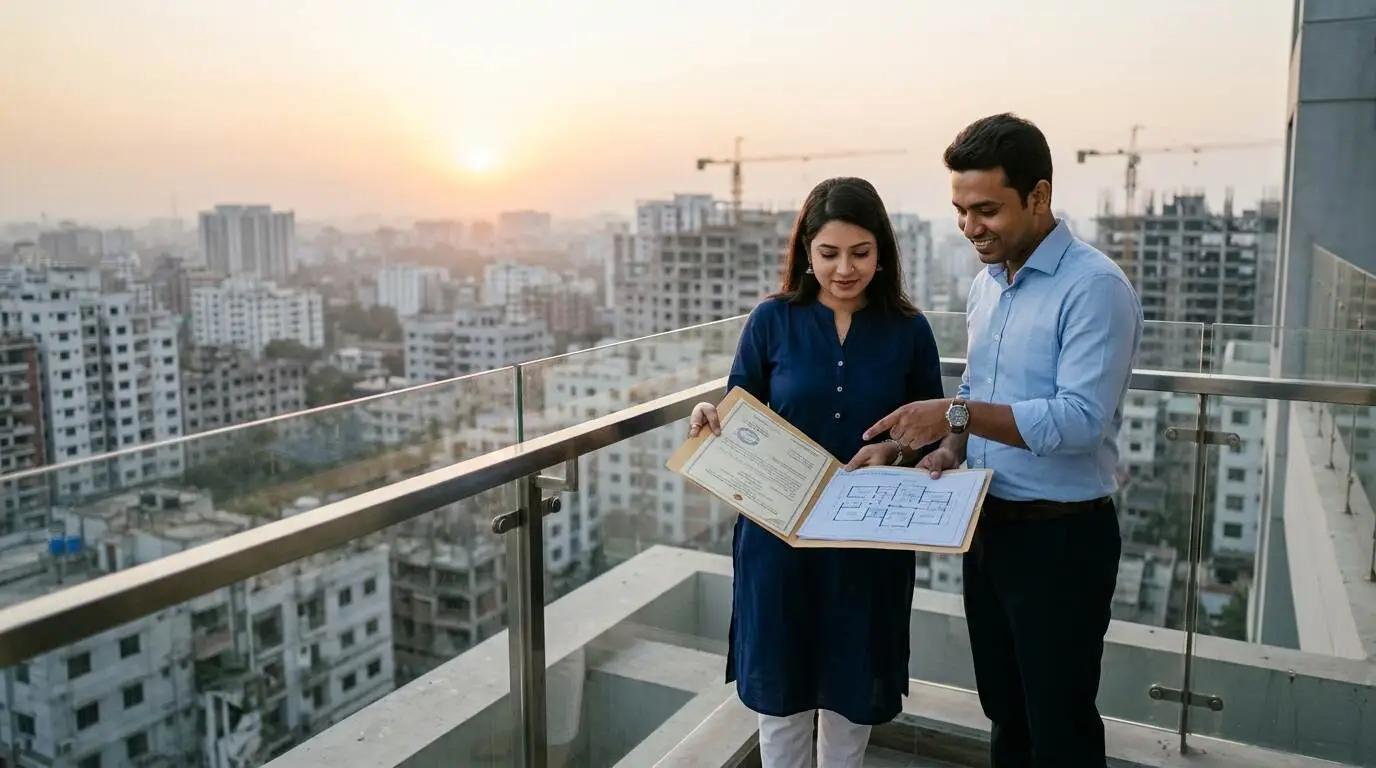
A real estate investment in Bangladesh typically yields 2.5% to 3.5% in net annual rental income for a standard flat in Dhaka, while closing costs (registration fees, stamp duty, taxes, and legal expenses) require an additional 8% to 12% above the purchase price.
Because rental yields are modest, long-term returns in Bangladesh rely primarily on capital appreciation, which makes thorough due diligence on the flat registration process in Bangladesh, clean land records (like the mother deed), and partnering with a trusted real estate company critical to protecting your money.
Navigating property ownership here means looking past sales brochures and focusing on three core fundamentals: realistic returns, legal verification, and total transactional costs.
Working with a trusted real estate company in Bangladesh helps ensure RAJUK compliance and clean deed transfers, providing a secure foundation for turning a flat or plot into a long-term asset.
What Dhaka property actually returns
Most sales pitches lead with headline rental yields.
An article in The Daily Star notes that Dhaka apartments typically yield only 2.5% to 3.5% in annual rent, and expenses like maintenance, vacancies, service charges, and taxes reduce those returns even further.
Other market trackers, such as KPLBD, show higher figures across neighborhoods, ranging from around 4.5% in older residential pockets to around 6% in a handful of high-demand areas.
The gap between these numbers comes down to how they're calculated. A "gross yield" is calculated by dividing annual rent by the purchase price.
A net figure is the actual money you keep after paying for maintenance, building charges, lost rent during empty months, and income taxes.
After deducting all costs, most standard Dhaka apartments generate a net rental return of 2.5% to 3.5%.
However, low rental returns do not mean you should avoid property investments. Instead, you just need to understand your primary goal. In Dhaka, real estate wealth comes mainly from capital growth, the flat increasing in value over time, rather than the monthly rental income you collect along the way.
A flat that appreciates 8% to 10% a year while yielding 3% in rent is still a decent asset. A flat bought purely for rental income at today's prices usually is not.
Why the market currently favors buyers
Throughout much of 2025, the real estate market in Bangladesh experienced a significant slowdown, with industry data from major developers shared with The Business Standard revealing that overall flat bookings and sales dropped by 20% to 35% across established firms. While luxury units priced above Tk 10 crore took an even steeper hit, falling by around 50%.
Developers blamed the market slowdown on political changes after the mid-2024 uprising, which made many buyers hesitant to purchase.
However, a slower market gives buyers more negotiating power. Developers with unsold or nearly finished flats are much more willing to offer lower prices, flexible payment schedules, or free add-ons like parking spaces and fittings.
If your finances and paperwork are ready, buying during a quiet market is actually an advantage, not a risk.
The five ways you can actually invest here
Building a resilient portfolio in today's market requires exploring diverse entry points that balance risk, yield, and liquidity.
Investors looking to allocate capital effectively can choose from traditional equities, real estate, fixed-income instruments, venture capital, and index funds. Equities offer direct ownership in high-growth enterprises, delivering long-term capital appreciation despite market volatility.
Real estate provides tangible asset security alongside steady rental yields, serving as a reliable hedge against inflation.
Meanwhile, fixed-income options like government bonds establish a stable baseline of returns for conservative risk profiles. Venture capital opens doors to early-stage innovations with massive upside potential. Though it requires higher risk tolerance and longer horizon commitments.
Finally, broad-market index funds allow investors to capture overall market growth with instant diversification and minimal management fees.
Choosing the right allocation for your risk profile
Selecting the ideal combination among these five vehicles depends heavily on your timeline, financial goals, and capacity for volatility.
Aggressive growth strategy seekers often lean toward a higher balance of individual equities and venture investments, accepting short-term market swings in pursuit of higher compounding rates.
Conversely, investors prioritizing capital preservation and steady income usually weight their portfolios toward fixed-income bonds and prime real estate assets. A balanced approach often pairs core index fund holdings with tactical allocations across the remaining asset classes to ensure both stability and capital growth.
Continually rebalancing these positions ensures your portfolio adapts to shifting market conditions while remaining aligned with your primary investment targets.
What it actually costs to buy
Buyers usually budget for the sale price and stop there. The registration process adds a real amount on top, and skipping this step is one of the most common budgeting mistakes first-time buyers make.
The government cut several registration-related taxes in 2025 and began aligning official deed values with actual market prices, so buyers no longer benefit from under-declaring a flat's value to save on tax under the latest property tax rates in Bangladesh for 2026.
Because different sources quote slightly different figures depending on when they were published and which city zone they cover, the table below provides a realistic range rather than a single fixed number.
Here's how the costs break down on an example flat priced at BDT 80 lakh:
| Cost item | Typical range | The estimated cost of an 80 lakh flat |
| Stamp duty | 1.5% | BDT 1.2 – 2.4 lakh |
| Registration fee | around 1% | BDT 80,000 |
| Local government tax | 2% – 3% | BDT 1.6 – 2.4 lakh |
| VAT (flat bought from a developer) | 2% – 4.5%, size-dependent | BDT 1.6 – 3.6 lakh |
| Gain tax (withheld at registration) | 3% – 4% in Dhaka city areas, after the 2025 cut | BDT 2.4 – 3.2 lakh |
| Mutation fee | flat fee | BDT 1,000 – 5,000 |
| Lawyer and deed-writer fees | around 1% – 1.5%, or a flat fee | BDT 80,000 – 1.2 lakh |
| Utility connection and misc. | flat fee | BDT 20,000 – 50,000 |
Add it up, and most buyers in Dhaka should plan for roughly 8% to 12% of the flat's price in registration-related costs, which comes to around BDT 6.5 to 9.5 lakh for an 80 lakh flat.
Properties in the highest-value zones of Dhaka, Chattogram, and Gazipur can land toward the top of that range or slightly above it.
Is the asking price fair?
You do not need a formal appraisal to sanity-check a price. Ask the developer or agent for the per-square-foot rate on two or three recent sales in the same building or block, then compare that to what you're being quoted.
If your unit is priced well above recent sales nearby with no clear reason, such as a better floor, view, or finish, that's worth raising before you commit.
Land or flat, which one to buy
Land or flat, which one to buy? This is the question most first-time investors struggle with, and the honest answer comes down to your personal risk tolerance, not just which option brings higher returns. Do not miss checking out our detailed apartment vs. land analysis.
| Factor | Land | Flat |
| Entry cost | Often lower per unit of area in emerging zones | Higher, but includes a finished, livable asset |
| Appreciation pattern | Can be faster in growth corridors, but less predictable | Steadier, tied to the building and the developer's reputation |
| Rental income | None | Yes, though modest at 2.5% – 3.5% net |
| Liquidity | Slower to sell, fewer buyers for raw plots | Easier to sell or rent, larger buyer pool |
| Title risk | Higher, especially with unclear inheritance chains | Lower with a REHAB-registered developer and clean paperwork |
| Ongoing cost | Minimal, but needs active protection against encroachment | Service charge and maintenance |
If you're buying to live in it or rent it out for a steady income, a flat from an established developer is the safer choice.
If you have capital you can leave untouched for years, and you're comfortable doing your own legal homework, land in a growth corridor can outperform. But it demands more patience and more due diligence up front.
Land carries higher title risk and earns nothing while you wait; flats carry developer risk and ongoing service charges, but come with income and liquidity that land usually can't match.
Where to buy: established areas versus emerging ones
Location decides most of your return before you even sign anything. Established neighborhoods like Gulshan, Banani, Uttara, and Bashundhara R/A carry higher entry prices but proven infrastructure, schools, and resale demand. You are paying for certainty.
Emerging areas such as Purbachal, Aftabnagar, and Jolshiri Abashon are less expensive to enter today and tend to appreciate faster as roads, schools, and utilities catch up with the planned layout.
Rupganj, sometimes grouped loosely with "Dhaka" real estate, actually sits in Narayanganj District, just outside Dhaka's formal boundary, which is worth knowing before you compare its prices to genuinely inner-city listings.
For an emerging area to gain real value over time, three key things must happen: promised infrastructure, like roads and utilities, must be built on schedule. Nearby institutions such as schools and hospitals must open as planned, and real residents must move in early to create genuine neighborhood demand rather than just market speculation.
Key Residential Projects in Jolshiri Abashon
PDL Real Estate’s Jolshiri Abashon has an active presence, is a planned township with wide roads and green space, and it already sits near established institutions such as Adamjee Cantonment Public School and College, Australian International School, North South University, and United International University, which shortens the wait for the infrastructure case to prove out.
For buyers specifically weighing Jolshiri Abashon, PDL Real Estate's own Property Shanti Sorobor, Property Bayt Al Nibrash, and Property Ayesha Sora are worth a look.
How to check a developer and the paperwork before you pay
Before you pay a single taka, go through this property registration documents checklist
RAJUK approval: Confirm the project has an approved building plan from RAJUK, Dhaka's development authority. An unapproved project can be halted mid-construction.
REHAB membership: The Real Estate and Housing Association of Bangladesh is the industry's main trade body. Membership is not a legal guarantee, but it signals that the developer operates under an accountability framework and provides a channel for escalating a dispute.
Mother deed and khatian chain: Trace ownership back through the mother deed and the full khatian record, including CS, SA, RS, and BS survey records, to confirm that the seller's title is unbroken and undisputed.
Mutation status: Check that the property has been properly mutated in the seller's name in the government records. An unmutated property can signal an unresolved ownership dispute.
Power of attorney validity: If someone other than the landowner is signing on the landowner's behalf, verify that the power of attorney is registered, current, and covers the specific transaction.
Joint venture agreement: If the project is a landowner-developer joint venture, ask to see the agreement and confirm which party actually holds authority to sell your specific unit.
Handover history: Ask about the developer's last two or three completed projects and how closely actual handover dates matched what was promised at booking.
Property Development Limited has operated in Bangladesh's real estate sector since 1983 as a sister concern of the PRAN-RFL Group, one factual point worth weighing alongside a developer's own track record rather than a substitute for checking it yourself.
What the law actually guarantees you
Bangladesh's Real Estate Development and Management Act, 2010, provides buyers with real, specific protections, yet few ever hear about them before signing.
If a developer fails to hand over your flat within the timeline in your contract, the law entitles you to a refund of everything you've paid, plus compensation, within six months. If your contract doesn't specify a compensation rate, the law sets it at 15% of the amount you paid, payable in up to three installments over that six-month window.
If you cancel a booking yourself, the developer can keep up to 10% of what you paid to cover incidental costs, but must return the rest within three months by a single cheque or pay order.
A developer also cannot sell you a mortgaged unit without your knowledge, and any mortgage on the property must be cleared before the deed transfer happens.
Changes to an approved architectural design without regulatory sign-off, and construction using materials that don't match the contract, are both punishable offenses under the same law.
None of this replaces good due diligence. But knowing these protections exist changes how you negotiate, and gives you a specific, legal answer if a developer stalls.
How buyers lose money on Bangladesh property
Most losses in this market trace back to a handful of repeat patterns.
Handover delay: A developer misses the promised completion date by months or years, tying up your money. And if you're renting elsewhere in the meantime, that's costing you twice over.
The 2010 Act's compensation and refund rules exist specifically for this, so you should check your contract's stated timeline before you sign, not after.
Developer default: A financially stressed developer stops construction entirely. REHAB membership and a track record of completed projects both reduce this risk before you buy. The Act's refund and compensation rules are your recourse if it happens anyway.
Joint venture disputes: Landowners and developers sometimes disagree mid-project over unit splits, construction pace, or contract terms. These disputes can completely stall sales and handovers.
Consequently, both the landowner and buyers who booked units face unexpected delays. Ask specifically about the landowner relationship for a JV project before booking.
Title defects surfacing after payment: Issues like a break in the ownership chain, an unresolved inheritance claim, or an unmutated record often surface only after you have paid.
This risk is precisely why you must complete the checklist beforehand.
Resale illiquidity: In areas where developers built faster than genuine demand grew, resale can take far longer than buyers expect. Prices can sit flat or fall while you wait.
This is a real argument for buying in areas where infrastructure and institutions are already in place or clearly on schedule. Rather than purely on the promise of future growth.
Paying for it
According to Noah Developments Limited, most banks and non-bank financial institutions in Bangladesh finance up to 70% of a flat's value, so plan for a down payment of at least 30% out of pocket.
According to The Daily Star, the state-run Bangladesh House Building Finance Corporation offers government-backed loans at a lower rate, generally in the 9%, for the Dhaka and Chittagong metro areas, while private banks and NBFIs typically charge 12% to 14%.
Here's the math that matters. Borrow BDT 56 lakh (70% of an 80 lakh flat) at around 12% over 20 years, and the monthly installment lands somewhere around BDT 60,000 to 65,000. Rent on that same flat at a 3% net yield brings in roughly BDT 20,000 a month. The loan payment is triple the rental income.
That gap is the whole point of this section. If you're financing a flat purely to rent it out, the numbers usually don't work at today's rates and yields.
The purchase has to be justified some other way, by the property appreciating in value over the years you hold it, or by you actually living in it and treating the mortgage as rent you'll eventually stop paying. Say that to yourself plainly before you borrow, not after.
A realistic first purchase
Here's a sequence that works for most first-time buyers.
- Set your total budget to include the 8%-12% registration cost on top of the sale price, not just the sale price.
- Shortlist two or three areas that match your reason for buying, whether that's schools nearby, a shorter commute, or growth potential.
- Verify the developer, checking RAJUK approval, REHAB membership, and their last few handover dates.
- Verify the paperwork, tracing the mother deed and khatian chain with a lawyer before you pay a deposit.
- Negotiate, especially in a slower market where developers have room to move on price or payment terms.
- Register the deed, budgeting for the full cost breakdown above, not an estimate.
- Mutate the property into your name promptly after registration, since this step actually protects your ownership in government records.
Final
Real estate in Bangladesh rewards patience more than it rewards speed. It rewards paperwork over promises, too.
The rental numbers alone rarely justify a purchase. A flat earning 2.5% to 3.5% a year in rent will not beat many other places to put your money on income alone. But rent was never the real reason to buy property in Dhaka. Appreciation has always done the heavier lifting, and it still does. That changes what a smart purchase actually looks like.
Buy in a location where the infrastructure case is already proven, not just promised in a brochure. Verify the developer and trace the paperwork before you pay a single taka.
Know your rights under the 2010 Act before you go in, or contact our real estate experts to guide you through property verification before you commit.
Do all of that, and property stays one of the steadier ways to build wealth in Bangladesh. Skip any part of it, and even the best location cannot save a bad purchase.
Frequently Asked Questions
Is buying a flat in Dhaka a good investment?
It can be suitable for personal use or long-term wealth building, but appreciation is not guaranteed. As a rental-only investment, the return is often modest, so calculate the net yield after vacancy, maintenance, service charges, taxes, financing costs, and transaction expenses.
What rental yield can I expect on a Dhaka apartment?
Use approximately 2.5%–3.5% as an indicative net-yield range for an ordinary Dhaka apartment after typical deductions. Gross yields can be higher and vary by neighborhood, purchase price, unit size, furnishing, and tenant demand.
How much does flat registration cost in Bangladesh?
Plan for roughly 8%–12% of the purchase price in registration-related and associated costs, including applicable stamp duty, registration fee, local government tax, VAT, taxes, mutation, and legal expenses. The exact amount depends on the property, location, deed value, and current tax rules.
Should I buy land or a flat?
A flat is generally more suitable if you want a home or potential rental income. Land may offer greater appreciation in a genuine growth corridor. But it produces no rent and usually carries greater risks related to title, inheritance, mutation, possession, and encroachment.
Can I invest in a REIT in Bangladesh right now?
Bangladesh has a BSEC REIT regulatory framework, with a minimum fund size of BDT 200 crore, or BDT 300 crore for funds investing exclusively in city-corporation projects, and at least 80% direct investment in real estate. Before investing, verify through current BSEC notices whether any fund has received approval and completed a public offering.
Can non-resident Bangladeshis buy property in Bangladesh?
NRBs may purchase property subject to Bangladesh’s land, tax, registration, foreign-exchange, and remittance requirements. Use authorized banking channels and complete the transaction with a qualified local lawyer.
How much money do I need to buy a flat?
You need the purchase price plus approximately 8%–12% for transaction-related costs. If you use financing, plan for a lender-dependent down payment, often around 20%–30%, but confirm the actual loan-to-value ratio, interest rate, fees, and eligibility requirements with the lender. BHBFC publishes a flat-loan product with a 25% buyer contribution and 75% financing ratio.
Real estate or the stock market?
Real estate is tangible but usually illiquid, concentrated, and expensive to transact. Stocks are easier to trade and diversify, but can be more volatile. Compare the two based on after-cost returns, risk, liquidity, investment horizon, and diversification needs.