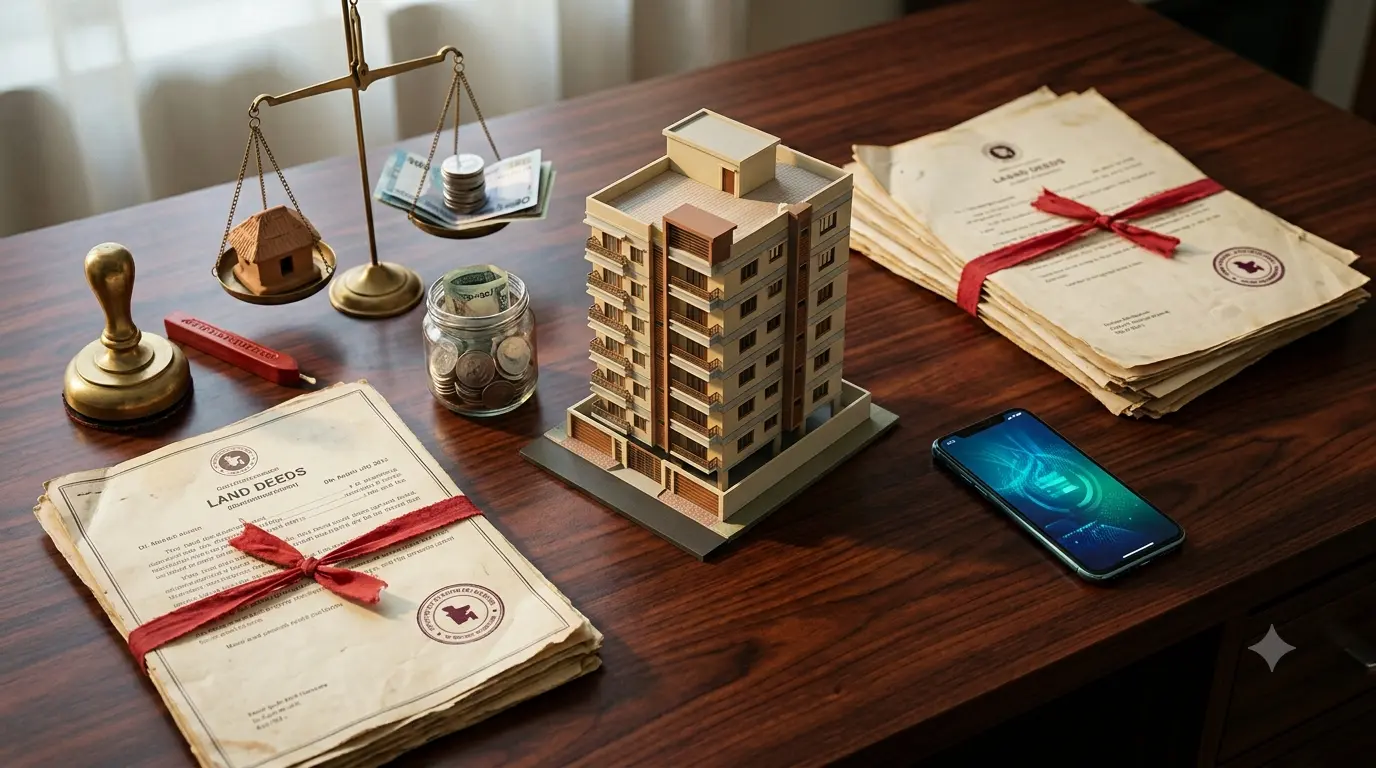
Property Tax in Bangladesh covers three distinct categories that every owner must understand before buying, holding, or selling real estate in 2026. Annual ownership taxes include Land Development Tax (LDT) and Municipal Holding Tax. Transactional taxes include stamp duty, registration fees, and capital gains tax that apply at the point of sale. Special surcharges apply when your total net wealth exceeds BDT 2 crore. Here, PDL Real Estate covers every rate, every step of the online payment process on ldtax.gov.bd, and the expert mistakes that cost property owners thousands of takas every year. Whether you own land in a village or a luxury apartment in Dhaka, you will find the exact numbers and steps that apply to your situation right here.
Understanding the Three Pillars of BD Property Tax
Property Tax in Bangladesh is not a single flat charge. It operates across three distinct pillars that apply at different stages of ownership.
Annual ownership taxes are paid every year simply for holding a property. Transactional taxes are triggered only when a property changes hands.
Special surcharges apply based on the individual taxpayer's total net wealth. Understanding which pillar applies to your situation determines how much you owe and to which government office you must pay it.
Annual Ownership Taxes: Land Development Tax (LDT) and Municipal Holding Tax
The Land Development Tax rate in Bangladesh applies to every parcel of land regardless of whether a building stands on it.
LDT is collected by the AC Land office and must be paid annually through the ldtax.gov.bd digital portal.
The rate ranges from BDT 1 to BDT 10 per decimal per year, varying by Mouza classification. Municipal Holding Tax is a separate annual charge collected by the Dhaka North City Corporation (DNCC), the Dhaka South City Corporation (DSCC), or local Pourashava councils on built properties within their jurisdictions. The two taxes are independent and must each be paid separately to their respective offices.
- Land development tax rate Bangladesh: BDT 1 to BDT 10 per decimal per year based on Mouza classification.
- Municipal Holding Tax: 12% of Annual Rental Value (ARV) divided across sub-components
Both taxes are due annually and carry penalty surcharges for late payment
Transactional/Transfer Taxes: Stamp Duty, Registration Fees, and Capital Gains
When a property changes hands, a completely different tax structure activates. Stamp duty for property transfer is currently 1.5% of the declared deed value for apartments across Bangladesh.
The land registration fee adds another 1%, and the local government tax adds a further 2%. Capital Gains Tax applies to the seller at 4% to 8% depending on area and property category.
Together, these transactional charges add 10% to 12.5% to the total cost of a property transaction and must be fully settled before the Sub-Registry Office will execute a deed.
Special Surcharges: Wealth Surcharge (for Net Worth >20 Million BDT) and AIT
The third pillar of Property Tax in Bangladesh targets high-net-worth individuals through the Wealth Surcharge.
Any taxpayer whose total net wealth exceeds BDT 2 crore (20 million BDT) is subject to a surcharge on top of their regular income tax, ranging from 10% to 35% of the assessed tax, depending on the total wealth bracket.
Advance Income Tax (AIT) is also deducted at source during property registration at 1% to 4%, depending on the property location.
AIT paid at registration is fully adjustable against your annual income tax return, so retaining all treasury challan receipts is essential.
2026 Fee Schedule: How Much Will You Actually Pay?
Property Tax in Bangladesh during a property transfer in 2026 adds up to roughly 10% to 12.5% of the declared deed value for most Dhaka apartments, and that figure does not include VAT or AIT.
Buyers who budget only the purchase price of a flat are regularly caught off guard by a registration bill that runs into several lakhs of takas.
The breakdown below gives you the exact components so you can calculate your total cost before you sign anything.
The 1,600 Sq. Ft. Rule: Why VAT Jumps from 2% to 4.5% Based on Apartment Size
VAT on apartment purchases is one of the most misunderstood charges in Bangladesh's Property Tax framework.
The National Board of Revenue (NBR) applies a 2% VAT rate on flats below 1,600 sq ft and a 4.5% VAT rate on flats of 1,600 sq ft and above.
A buyer purchasing a 2,000 sq ft apartment for BDT 1.2 crore pays BDT 54,000 in VAT alone, compared to BDT 24,000 for a smaller flat at the same declared price.
Selecting a flat just under the 1,600 sq ft threshold is a legitimate and legal tax planning consideration worth raising with your developer before signing a purchase agreement.
Registration Breakdown: Mapping the ~10-12.5% Total Cost of Land and Apartment Transfers
The table below maps every component of the registration cost for a typical Dhaka apartment transaction in 2026:
| Cost Component | Rate (Apartment in Dhaka) |
| Stamp Duty for Property Transfer | 1.5% of deed value |
| Land Registration Fee | 1% of deed value |
| Local Government Tax | 2% of deed value |
| Gain Tax (Seller) | 4% to 8% based on area |
| VAT (below 1,600 sq ft) | 2% of purchase price |
| VAT (1,600 sq ft and above) | 4.5% of purchase price |
| Advance Income Tax (AIT) | 1% to 4% based on location |
| E-Registration Service Fee | BDT 500 flat |
Model: A flat purchased for BDT 60,00,000 under 1,600 sq ft would incur approximately BDT 6,90,000 in combined stamp duty, registration fee, local tax, and VAT before AIT and miscellaneous charges are added.
The Mouza Rate Trap: Understanding Why Government Rates Differ from Your Purchase Price
The government calculates Land development tax rates in Bangladesh and certain transfer taxes using the official Mouza Rate, which is the government-assessed value per decimal for each revenue Mouza area.
The rate is almost always below the actual market price you paid. The critical point many buyers miss is that stamp duty and registration fees are calculated on whichever is the declared deed value or the Mouza Rate.
Declaring a value below the Mouza Rate will result in your registration being rejected at the Sub-Registry Office. Always confirm the applicable Mouza Rate for your property's location before drafting the deed.
Pre-Tax Checklist: Is Your Property "Tax-Ready"?
To pay Property Tax in Bangladesh correctly in 2026, your property must meet three digital prerequisites.
One is a completed mutation in your name, then a perfectly synced NID and e-TIN record, and a valid Holding Number if the property is inside a city corporation boundary.
Missing any single one of these will trigger system errors that block your payment and can create a false record of non-payment against your property.
Digital Mutation (Namjari): Why Your Dalil Isn't Enough to Pay Taxes in 2026
A registered Sale Deed (Dalil) proves you legally purchased the property, but it does not update the government khatian record in your name.
Mutation, or Namjari, is the separate administrative process that transfers the khatian entry from the seller to the buyer at the AC Land office.
Without a completed mutation, the ldtax.gov.bd portal will display the previous owner's name when you search by plot number.
You cannot legally pay Land Development Tax in your name until mutation is finalized. Unpaid taxes create encumbrance issues that surface during future sales or mortgage applications.
e-TIN and NID Sync: Avoiding "Record Not Found" Errors by Matching Spellings Exactly
The most common technical error when making an online land tax payment is a mismatch between the name on your National Identity Card and the name registered on your e-TIN certificate with the National Board of Revenue.
The ldtax system cross-checks both databases simultaneously. Even a single character difference, such as "Mohammed" versus "Mohammad," will return a "Record Not Found" error and prevent payment entirely.
Verify that your full name appears identically across both systems before beginning any online tax payment process.
Obtaining Your Holding Number: The Account ID for City Corporation Services
Your Holding Number is the unique identifier assigned to your property by the Dhaka North City Corporation or DSCC.
It functions like an account number for all municipal tax payments, utility connections, and building service requests.
If you purchased an existing property, the Holding Number transfers to you once mutation is recorded with the City Corporation.
For newly constructed properties, apply for a Holding Number at the relevant City Corporation office with your approved building plan, registered deed, and mutation certificate in hand.
Step-by-Step: Paying Land Tax (LDT) from Your Smartphone
Property Tax in Bangladesh for land has been fully digitized through the ldtax portal, which accepts payments via bKash, Nagad, and bank transfer.
The entire process takes under 10 minutes once your property records are mutation-updated and your NID biometric is verified in the system.
Registering on the ldtax.gov.bd Portal with Your NID
Visit ldtax.gov.bd and select "New Registration." Enter your 17-digit NID number and your date of birth as it appears on your card.
The system automatically verifies your identity against the Bangladesh Election Commission database.
Once verified, create a password and confirm via the OTP sent to your NID-linked mobile number.
If your NID is not yet linked to a mobile number in the Election Commission system, you must update your NID record at your nearest Upazila Election Office before the portal registration can be completed.
Selecting the Correct Mouza and District (The Most Common Error)
After logging in, navigate to the "Pay Tax" section and select your Division, District, Upazila, and Mouza in that exact sequential order.
The most common mistake is selecting the administrative Mouza name rather than the revenue Mouza name as it appears in the khatian document.
These two names are frequently different and cannot be used interchangeably in the portal. Always copy the Mouza name exactly as written in your khatian. An incorrect Mouza selection will either return no results or display another person's land records entirely.
Completing the Payment via bKash/Nagad and Downloading the QR-Coded Dakhila
Once you confirm your plot details and the portal displays the outstanding tax amount, select your preferred mobile financial service from the options shown.
The portal supports bKash, Nagad, and Rocket. Authorize the payment inside your mobile banking app when the redirect appears.
After a successful payment, the portal generates a Dakhila receipt with a unique QR code that any government official can scan to instantly verify its authenticity.
Download and save the PDF to your device immediately upon generation, as re-downloading later requires a support request to the ldtax.gov.bd helpdesk.
Managing City Corporation Holding Taxes
Municipal holding tax calculation for properties within Dhaka is based on the property's Annual Rental Value (ARV), not its market price or deed value.
The total Property Tax in Bangladesh, including holding tax, is 12% of ARV, distributed across four sub-components, and must be paid quarterly or annually to the relevant City Corporation by their published deadlines.
Calculating "Annual Rental Value": How the 12% Total Rate Is Assessed
Municipal holding tax calculation starts with the ARV figure assigned by the City Corporation based on your property's location, floor area, construction type, and usage. The 12% rate is then divided as follows:
- General Holding Tax: 7% of ARV
- Conservancy and Sanitation Tax: 2% of ARV
- Street Lighting Tax: 1.5% of ARV
- Water and Sewerage Surcharge: 1.5% of ARV
For a flat with an assessed ARV of BDT 3,00,000 per year, the total annual holding tax is BDT 36,000 or BDT 9,000 per quarter.
Property owners who believe their ARV has been assessed too high may file a formal objection with the City Corporation within 60 days of the assessment notice.
Quarterly vs. Annual Payments: Maximizing Your Tax Rebate (Up to 10% for Advance Payment)
City Corporation holding taxes may be paid in four quarterly installments or as a single lump sum for the full year.
Property owners who pay the entire annual amount in advance during the first quarter receive a confirmed 10% rebate on the total bill.
On a BDT 36,000 annual holding tax, this rebate saves BDT 3,600 per year. Over 10 years of ownership, that equals BDT 36,000 in guaranteed savings with zero additional effort.
Annual advance payment is always the financially superior option for any property owner with sufficient liquidity.
Interim Re-assessment: What Happens When You Renovate or Extend Your Building
Any significant renovation, vertical extension, or change of use of a property within City Corporation limits legally obligates the owner to notify the holding tax office for a formal re-assessment.
The City Corporation may inspect the property and revise the ARV upward if undisclosed construction is identified.
The revised tax applies retroactively from the date the construction was completed, not the inspection date.
Buyers of renovated apartments should always confirm whether the previous owner notified the City Corporation of any changes, as outstanding reassessment tax liabilities automatically transfer to the new owner.
Common Pitfalls and Expert Tips
Understanding Property Tax in Bangladesh on paper is one thing, but the practical experience at government offices presents additional realities that every buyer must be prepared for.
The three expert insights below address the most frequently reported problems by property buyers and lawyers active in the Dhaka market in 2026.
The "Office Tea" Reality: Budgeting for ~2% in Miscellaneous Registration Charges
Experienced buyers in Bangladesh budget an additional 1.5% to 2% of the deed value for informal facilitation at various points in the registration process, including deed-writer fees, notary and stamp costs, documentation charges, and in-office service payments.
These are not government-approved fees and should never be paid as official government charges. However, ignoring this reality leads to unexpected delays.
Choosing a trusted real estate company in Bangladesh, such as PDL Real Estate, significantly reduces these encounters because documentation is handled by professionals, clearances are provided in advance, and buyers are supported through the process from day one.
Undisclosed Property: Understanding Sections 19AAAAA and 19BBBBB for Declaration
Bangladesh income tax law provides special amnesty-style provisions under Sections 19AAAAA and 19BBBBB of the Income Tax Act 2023, which allow taxpayers to disclose previously undeclared property assets by paying a specified tax rate and surcharge without facing further legal inquiry.
For undisclosed land or apartment assets, the applicable rate is typically 15% of fair market value plus a 10% surcharge.
These provisions have specific eligibility windows and conditions. Consulting a registered tax consultant before attempting to use them is strongly recommended to avoid triggering a tax audit instead of resolving one.
Professional Legal Shield: When to Hire a Specialist to Handle "Under-the-Table" Negotiations
If you encounter requests for unofficial payments during a title search, mutation, or registration, engaging a licensed property lawyer or a registered tax consultant serves as a professional buffer that typically eliminates or sharply reduces such demands.
Lawyers are familiar with official processing timelines and can cite specific regulations to enforce compliance.
Their fees range from BDT 10,000 to BDT 50,000 depending on transaction complexity, which is far less than the cost of a disputed title or an incorrectly registered deed discovered years after purchase. For high-value apartments in Dhaka, professional legal support is more essential than ever.
Final Takeaway
Property Tax in Bangladesh in 2026 is far more manageable when you know exactly which taxes apply to your situation, what the correct rates are, and how to prepare your records before making a single payment.
Annual LDT on land, municipal holding tax on built properties, and transactional taxes during a sale each operate through separate systems and separate deadlines.
Complete your mutation before attempting any digital tax payment, verify that your NID and TIN spellings match exactly, and always opt for the annual advance payment to capture the 10% rebate.
Whether you are buying your first flat in Jolshiri Abashon or managing inherited land in Narayanganj, these steps apply directly to your situation and are current as of the 2026 regulatory framework.
Frequently Asked Questions on Property Taxes in Bangladesh
What is the current land tax rate per decimal in Bangladesh for 2026?
Land Development Tax ranges from BDT 1 to BDT 10 per decimal annually, depending on the Mouza classification.
How much is the total registration fee for an apartment in Dhaka?
Total registration-side costs for a Dhaka apartment range from 10% to 12.5% of the declared deed value.
Is VAT applicable on land purchases in Bangladesh?
No. VAT applies to apartment purchases only. Bare land transactions do not attract VAT under current NBR rules.
What is the difference between a Sale Deed (Dalil) and Mutation?
A Sale Deed proves legal purchase in court. Mutation updates the government khatian record to reflect the new owner's name.
How can I find my property holding number online?
Visit your City Corporation's official website and search using your plot number or registered address to locate your Holding Number.
What happens if I miss the property tax payment deadline in Bangladesh?
A penalty surcharge of 6.25% per year is applied on outstanding Land Development Tax amounts from the date payment was due.
How much house rent is tax-free for individual owners in Bangladesh?
Up to BDT 25,000 per month in rental income is currently tax-exempt for individual property owners in Bangladesh.
What is the threshold for the Wealth Surcharge on properties?
The Wealth Surcharge applies when a taxpayer's total net wealth exceeds BDT 2 crore (BDT 20 million) as assessed annually.