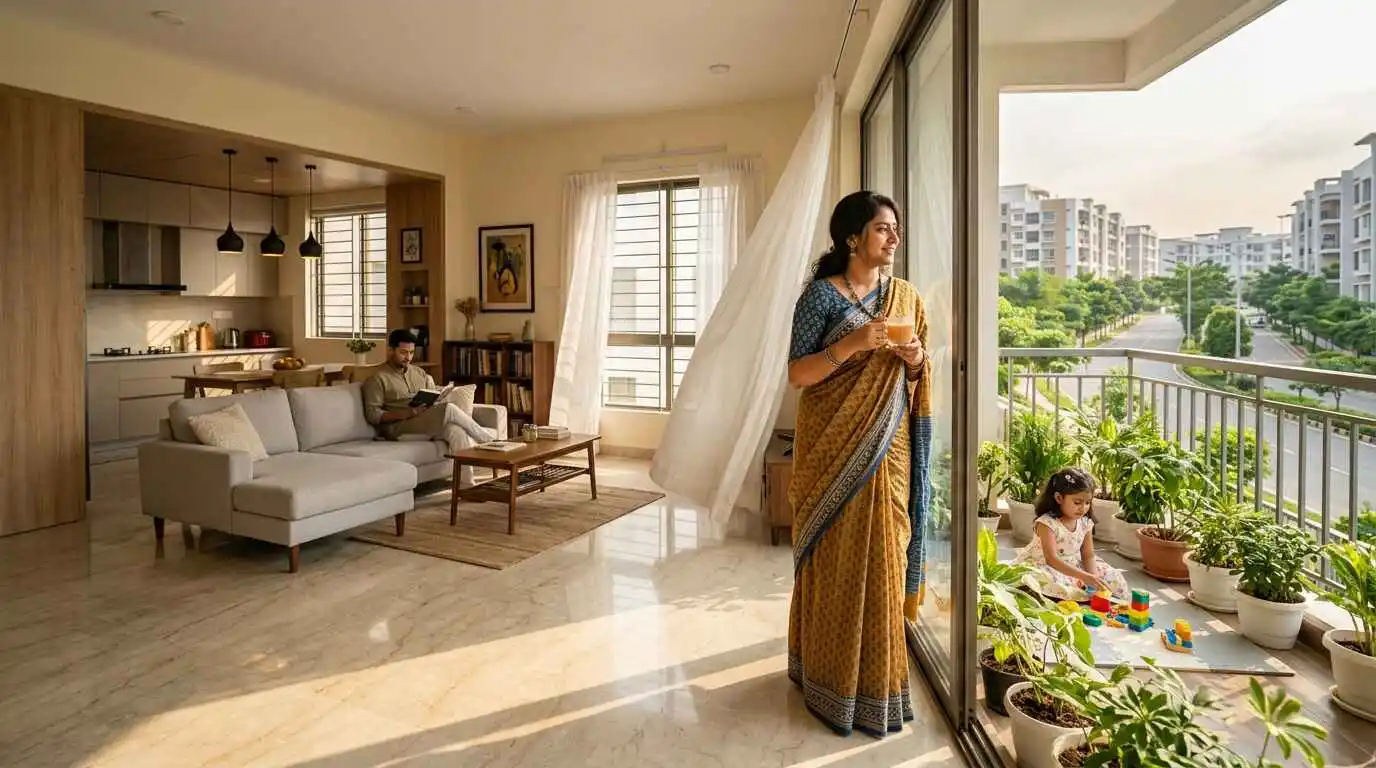
Most people think about a home in terms of size and location. How many bedrooms. Which floor. How far from work.
But where you live affects far more than your commute. Your home shapes how you sleep, how your mornings go, how your family spends time together, and how stressed you feel by evening. This isn't a vague idea. Researchers have studied it, and the findings are consistent.
This article covers the real ways your home affects your daily life, and what to look for when you're choosing one.
Your Morning Starts at Home, Not Outside It
Before you leave for work, your home either helps you or fights you.
Think about your morning. Where is the bathroom relative to the bedroom? Does your kitchen get enough light to feel awake in at 7am? Is your balcony a place you actually step onto, or is it too cramped to bother?
These things seem small. They are not.
A home with a sensible layout moves your morning along. One with a confusing floor plan creates small frustrations, and small frustrations, repeated every single day, wear you down.
Natural light in the morning also matters more than most people expect. Research published in the journal Archnet-IJAR found that bedroom placement relative to sunlight directly affects how well residents sleep and how alert they feel in the morning. The World Council for Green Buildings has documented that people exposed to natural light during the morning hours are 18% more productive through the rest of the day.
This applies at home just as much as at work. Sunlight in your bedroom and kitchen at the start of the day is not a luxury. It sets up the hours that follow.
PDL Real Estate builds apartments with this in mind. Spacious balconies, functional kitchen layouts, and room orientations that bring in natural light where residents actually spend their mornings. You can read how this design thinking translates into real projects in the guide on how PDL creates communities in Jolshiri and beyond.
Light and Air Make a Bigger Difference Than You Think
If you have ever spent a few days in an apartment with poor ventilation, you already know this. By mid-afternoon, the air feels heavy and your energy drops. Most people blame the heat. Often, the real problem is the building.
The World Council for Green Buildings found that proper ventilation increases daily productivity by 5 to 14 percent. A briefing from Harvard University by psychiatrist Joseph Allen concluded that better indoor air quality has a direct positive effect on mental health. Poor ventilation traps humidity, odors, and airborne particles. All of that raises stress and reduces sleep quality over time.
In Dhaka's climate, this is not a minor point. The heat and humidity here make cross-ventilation a basic need. Cross-ventilation means windows positioned on opposite sides of the apartment so that fresh air actually moves through. Without it, air sits still no matter how many fans you run.
When viewing an apartment, test this. Open windows on opposite sides and feel whether there is any movement. A well-ventilated apartment and a poorly ventilated one can cost the same. They do not feel the same to live in.
Natural light works in a similar way. A study in Archnet-IJAR found that window placement and outdoor views are among the highest-impact design factors for mental wellbeing in residential buildings. Natural light helps regulate your body's internal clock, reduces daytime sleepiness, and supports better sleep at night.
If you want a practical breakdown of which amenities — including ventilation design and air quality systems — actually improve daily life in a Dhaka apartment, the article on luxury apartment amenities in Dhaka covers this in depth.
A Good Layout Changes How You Move Through Your Day
Floor plans are not just about square footage. They are about friction.
A poorly designed layout forces you to cross the entire apartment to do simple things. A bedroom placed too close to the main entrance. A kitchen cut off from the living area. A bathroom shared between children's bedrooms and the guest area. These are not dramatic flaws, but they create daily tension that builds up quietly.
A sensible layout reduces unnecessary movement. It separates noisy areas from quiet ones. It gives each part of the family enough space to function without constantly overlapping.
Research in urban housing design consistently shows that interior layout has a direct effect on daily stress. When rooms connect naturally and each space has a clear purpose, residents report lower stress and higher satisfaction, even in smaller apartments.
For families in Dhaka, this is especially relevant. Bangladesh has seen a major shift from joint family homes to nuclear families in city apartments. In a joint family home, there were always extra rooms to retreat to or gather in. In a city apartment, the floor plan has to do more work with less space.
The bedroom should sit away from street noise. The living room should bring the family together, not push people into separate corners. The kitchen should feel connected to where the family gathers, not isolated at the back.
Good design handles all of this without the family having to adapt around it. The article on the future of urban living in Dhaka explores how design priorities in new residential developments are shifting to reflect exactly this.
Your Home Affects How Your Family Grows Together
This is the part many developers skip over.
A home does not just house a family. It shapes how that family spends time together. The spaces inside and around an apartment determine whether children have room to play safely, whether parents have somewhere to unwind, and whether neighbours become a community or stay strangers.
Research published in Frontiers in Public Health studied more than 7,000 children aged 3 to 4 in rural Bangladesh. It found that the home environment, including the physical space and the shared activities it makes possible, is directly linked to early childhood development. A cramped, understimulating home slows that development. A well-designed one supports it.
Beyond the individual apartment, what surrounds it matters too.
In Bangladesh, there is a useful distinction between bashon and abashon. Bashon means a place to stay, four walls and a roof. Abashon means a complete residential environment with play areas, shared gardens, community halls, and safe outdoor space. For a long time, most developers in Dhaka built bashon. Today's buyers want abashon, and for good reason.
When children can play safely in a rooftop garden or a fenced compound, parents can actually relax. When neighbours share a community hall, they stop being strangers. These shared spaces are not optional extras. They are what turns a building into a neighbourhood.
PDL Real Estate includes safe play zones, rooftop gardens, and community spaces in its residential developments. The article on how PDL creates communities shows specifically how the one-unit-per-floor building model, used in all Jolshiri projects, creates smaller, closer-knit communities where families actually know their neighbours.
Security and Peace of Mind Are Part of Your Lifestyle Too
It is hard to feel settled somewhere you do not feel safe.
In Dhaka, security is consistently one of the main reasons people choose a planned residential community over a traditional apartment building. A study of gated community residents in Dhaka found that 78 percent of them noticed a clear reduction in daily stress after moving from standard housing.
Good security in a residential building looks like specific things. A 24-hour guard post at the entry point. CCTV covering common areas and parking. Controlled access for visitors. An intercom system between individual apartments and the main gate.
These features change daily life in practical ways. Children can use shared spaces without a parent watching every second. You do not think twice about arriving home after dark. Visitors can be checked before they enter. That reduction in background worry is real, and it compounds across every day you live there.
Planned residential areas like Jolshiri Abashon are specifically designed around this kind of security. If you are comparing where to buy, the article on why location matters when choosing an area for your family explains how the neighbourhood around your building is just as important as the building itself.
When viewing a building, ask about the security setup directly. Who is on the gate overnight? Are the cameras actively monitored, or only recorded for later review? Is there a generator to keep the system running during power cuts? A brochure will not answer these questions. The building management will.
Your Home Reflects Where You Are in Life
In Bangladesh, choosing a home is not a routine purchase. It is a considered decision that most families make once or twice in a lifetime.
Research on urban housing in Dhaka shows that residents today want a home that fits their life stage, not just their budget. A young family looks for proximity to schools, safe play space, and room for children to grow. An older couple looks for quiet floors, reliable lifts, and a well-maintained building. These are different things, but the underlying need is the same: a home that works for the life you are actually living.
The developer matters as much as the apartment itself.
An on-time handover lets you plan your family's life around a real date. A delayed one disrupts school schedules, extended family arrangements, and financial planning. A developer with a documented track record of on-time delivery is not just a marketing point. It is the difference between planning with confidence and spending two years in uncertainty. The article on why on-time project handover matters in real estate covers this in detail, including the financial and emotional costs families absorb when a handover is delayed.
PDL Real Estate is backed by PRAN-RFL Group, one of Bangladesh's most established business conglomerates, with more than 40 years of operating history in the country. That backing affects material supply chains, engineering oversight, and financial stability, all of which connect directly to whether your home is handed over when it was promised.
When you invest in a home, you place trust in a developer. That trust should come with evidence behind it.
What to Actually Look for When Choosing an Apartment
Reading about home design is useful. Walking through an apartment with specific questions is better.
If you are buying for the first time, the first-time homebuyer's guide for Bangladesh is worth reading alongside this checklist. It walks through financing, legal checks, and what to verify before signing.
Here is what actually matters when you visit:
Natural light. Which direction do the main rooms face? East-facing bedrooms get morning sunlight. South-facing rooms get the most light across the day. Ask when and where sunlight enters, and visit at different times if you can.
Cross-ventilation. Are there windows on at least two opposite sides of the apartment? Open both and feel whether air moves. In Dhaka, cross-ventilation is not optional.
Floor plan logic. Walk through your morning routine in your head while you are there. Bedroom to bathroom. Kitchen to dining area. Does the movement feel natural, or does it require a long detour? A layout that feels awkward on a first visit does not improve after you move in.
Bedroom placement. Is the master bedroom on the road-facing side? If yes, that is traffic noise at 6am, every day. A bedroom facing an internal courtyard or set back from the road is a different experience.
Balcony size. A balcony under 4 square metres is mostly decorative. A usable balcony where you can sit with a cup of tea or let a child stand in the morning air is a meaningful part of daily life.
Community facilities. Play zones, rooftop gardens, and community halls are what separate a building from a neighbourhood. Ask what is included and whether it is already built or still planned. The article on modern residential hubs in Jolshiri and beyond shows what a well-planned area actually provides versus what a single building can offer.
Security setup. Ask about guards, camera coverage, visitor management, and generator backup. Do not assume. Confirm.
Developer track record. Has the developer delivered past projects on time? Are buyers in completed projects satisfied? Look for actual handover histories, not just sales brochures.
Frequently Asked Questions
Does apartment layout really affect daily life?
Yes. A poorly designed layout adds friction to simple tasks, things you do every morning and evening. That friction is small each time, but it adds up over months. A well-designed floor plan makes daily routines feel natural rather than something to work around.
How does natural light affect your health at home?
Natural light helps regulate your body's internal clock, which controls your sleep cycle. Research shows it increases daytime productivity by up to 18 percent and is linked to lower stress, better mood, and improved sleep quality at night. Apartments with windows on multiple sides get the most benefit.
What is the difference between bashon and abashon in Bangladesh?
Bashon means a basic place to stay, four walls and a roof. Abashon means a full residential environment with community spaces, security, greenery, and shared facilities. Most buyers in Dhaka today want abashon. The distinction matters because it determines whether your building becomes a community or just stays a building.
How does a home affect children's development?
Research published in Frontiers in Public Health, studying children in rural Bangladesh, found that the home environment, including the physical space and the shared activities it allows, directly affects early childhood development. A cramped, noisy, or understimulating home can slow that development. A well-designed one supports it.
What apartment features most affect lifestyle quality?
Natural light and ventilation, a logical floor plan, bedroom placement away from noise, a usable balcony, 24-hour security, community facilities, and a developer with a verified on-time delivery record. None of these are luxury features. They are the basics of a home that actually works for the people living in it.