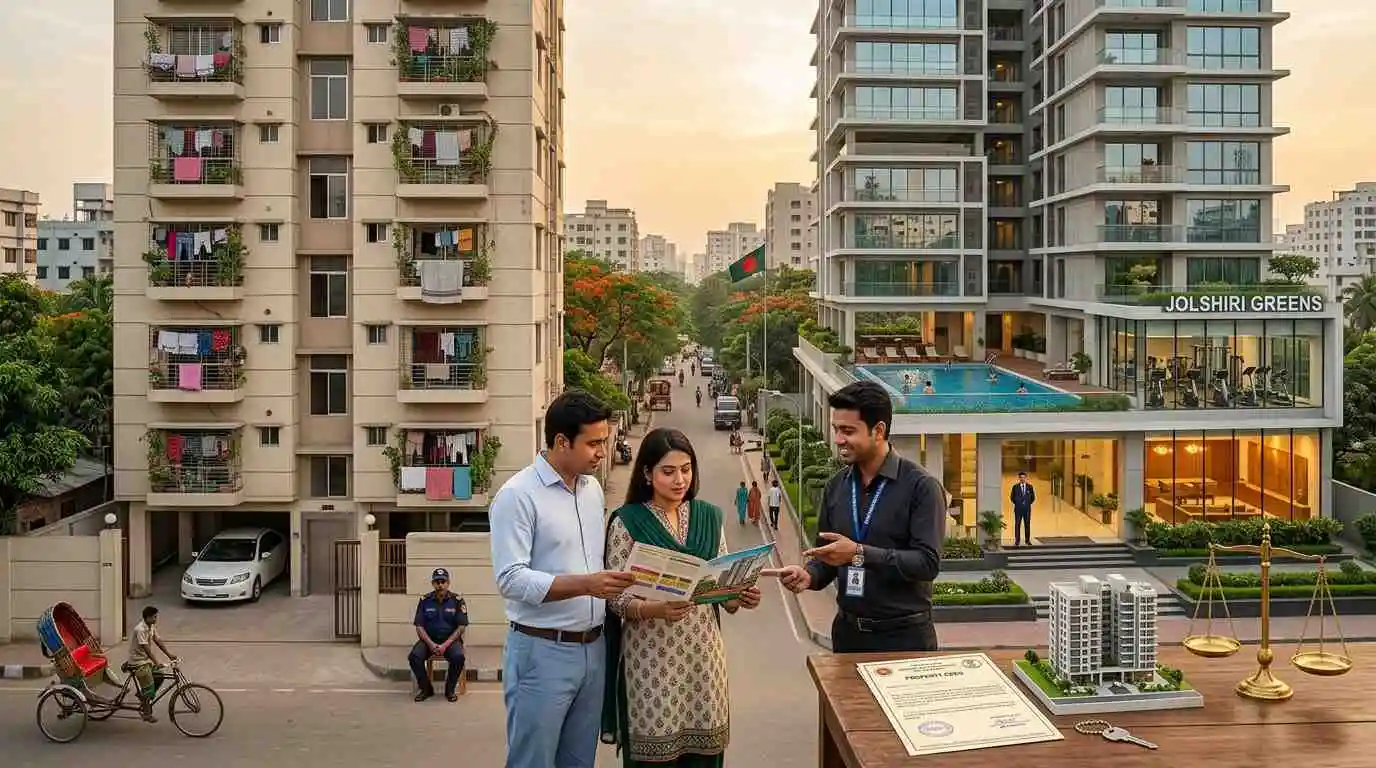
In Bangladesh, there is no legal difference between apartment and condominium properties; both grant individual ownership of a flat along with a proportional share of undivided land under the Real Estate Development and Management Act, 2010.
The practical distinction comes down to lifestyle and branding: a condominium refers to a premium, high-density residential complex featuring resort-style shared amenities and full-service facility management, whereas a standard apartment focuses on essential living spaces with lower ongoing maintenance costs.
Understanding these nuances is essential whether you are looking for an entry-level home or an amenity-rich residence.
Navigating property types, legal verification, and land-share terms becomes much simpler when partnering with a trusted real estate company in Bangladesh that can guide you through every stage of the buying process.
The short answer
There is no legal difference between an apartment and a condominium in Bangladesh. Both are individually owned flats in a shared building, and the same law applies to both: the Real Estate Development and Management Act, 2010.
When a developer calls a project a "condominium," they usually mean it offers extra amenities, like a gym, a pool, or a dedicated management team, not that ownership works differently.
So the real question is not "which one gives me stronger legal ownership."
It is "which building gives me the features and price I actually want." The sections below explain how to tell the two apart in daily life, even though the paperwork looks nearly identical.
Quick comparison at a glance
Here is what actually changes between a standard apartment and a condominium-branded project in Dhaka, side by side.
| Feature | Standard Apartment | Condominium-Branded Project |
| Ownership model | You own the unit plus a land share | Same: you own the unit plus a land share |
| Governing law | Real Estate Development and Management Act, 2010 | The same law applies |
| What the word means | Everyday term for any owned flat | Marketing term for a premium, amenity-heavy building |
| Typical amenities | Lift, parking, and a security guard | Pool, gym, community hall, dedicated facility staff |
| Monthly service charge | Often, a flat fee of around Tk 5,000 | Often Tk 8 to Tk 12 per square foot |
| Price per square foot | Standard market rate for the area | Usually, Tk 3,000 to Tk 5,000 higher per square foot |
| Documents required | Sale deed, mutation, RAJUK approval | Same set of documents |
Why the international definition does not apply in Bangladesh
In the United States and many Western countries, an apartment is a rented unit in a building owned by a single landlord or company. A condominium, or condo, is a unit that an individual owns and can either live in or rent out.
That gap creates most of the confusion online about the difference between condominiums and apartments in Bangladesh, because people apply a Western rule that ownership determines the label. Bangladesh does not work that way.
Nearly every flat sold here, whether the sign says apartment, flat, or condominium, goes to an individual buyer who owns it outright.
Dhaka's for-sale market has no real equivalent to the "apartment" model, where one company owns an entire building and rents out units one by one, as it does in cities like New York or Toronto.
Once you understand this, most of the confusion clears up. In Bangladesh, "condominium" refers to a building style, not a separate ownership system.
What does an apartment or flat mean in Bangladesh
An apartment, also called a flat, is a residential unit inside a multi-story building that a buyer purchases outright. People use this word every day across Dhaka, from Mirpur to Uttara to Jolshiri Abashon.
If you ask about "flat" vs. "apartment" in Bangladesh, the two words mean exactly the same thing. Buyers, sellers, and lawyers use them interchangeably in conversation and in property documents alike.
An apartment can be small and simple, or large and finely finished. Size, floor count, and price do not decide whether people call something a flat or an apartment.
The word simply describes the housing type: one unit among many in a single building on a shared plot of land.
What a condominium means in Bangladesh
In Bangladesh, the term "condominium" usually refers to a specific type of project: a taller building with resort-style amenities, professional facility management, and a higher price tag.
Developers use the word to signal that a project goes beyond the basics. Think swimming pools, fully equipped gyms, community halls, and round-the-clock concierge-style service, features that a standard apartment building rarely includes.
Legally, though, a condominium is still just an apartment. The buyer still purchases the unit rather than renting it.
The buyer still receives a share of the land.
The same national law still protects the sale.
What is a condominium in Bangladesh, then? It is really a premium apartment with a different name and a bigger amenities budget, not a separate class of ownership.
Real examples in the Dhaka market
Condominium-branded buildings have grown fast in Dhaka. Condominium-branded buildings have grown fast in Dhaka, particularly in planned townships where buyers prioritize generous space and privacy. In Jolshiri Abashon, G+M+8 developments such as Property Ayesha Sora, Property Elysian Bliss, Property Bayt Al Nibrash, and Property Shanti Sorobor reflect this standard.
By offering single-unit-per-floor layouts with 2,850 sq. ft. apartments across just 8 exclusive units, these projects deliver the spaciousness and community scale typically sought in premium residential complexes.
According to The Business Standard, the Real Estate and Housing Association of Bangladesh (REHAB) reports that developers completed 184 condominium projects over the past 16 years, across the country, which can accommodate about five lakh people
Buyers in these well-connected, higher-income areas often expect hotel-style facilities as a baseline.
Looking across modern ongoing and upcoming residential projects in Dhaka, developments like a landmark fifteen-story condominium building in Paribagh with 150 units (ranging from 2,471 to 3,171 square feet) highlight the modern shift toward amenity-rich living. Each is priced above one crore taka.
Featuring a shared gym rather than separate facilities for men and women.
Projects like this show what a condominium project in Dhaka typically offers: larger floor plates, taller towers, and amenities bundled straight into the purchase price.
The label changes, but as covered above, the underlying ownership structure stays the same as in any apartment.
Ownership and paperwork: what actually differs (and what doesn't)
Whether you buy a flat labeled as an apartment or a condominium, the ownership process is almost identical. The building itself can look completely different. What stays the same matters far more than what changes.
The documents are the same for both
Both purchases follow the same property buying process in Bangladesh, including the sale agreement, registered deed, mutation, and approval checks. You sign a sale agreement, receive a registered deed, complete mutation at the local land office, and confirm that RAJUK or the relevant local authority approved the developer's design.
None of these steps changes just because a sign outside the building reads "condominium" instead of "apartments."
Banks and lawyers treat the two words the same way, too. A registered deed for a condominium unit looks identical on paper to one for a standard flat.
If a seller tells you the paperwork works differently or moves faster for a condominium.
Treat that claim as a warning sign, not a selling point.
Where the Real Estate Development and Management Act, 2010 protects you
The Real Estate Development and Management Act, 2010, is the primary law governing apartments and condominiums in Bangladesh. It requires developers to register before selling real estate.
It defines exactly what counts as common space, items like lift lobbies, staircases, and guard rooms, which every buyer has a right to use.
The Act gives buyers real leverage. If a developer hands over your unit late, you can claim compensation as spelled out in your sale agreement, under the Act's delay provisions.
After handover, the law requires the developer to maintain the building for one year and remain responsible for structural repairs during that period, under the same set of rules for every project.
If a dispute arises, the Act first pushes both sides toward a mutual settlement, then toward arbitration under the Arbitration Act, 2001, if talks fail.
What changes in a condominium project
One real legal detail deserves close attention: your undivided share of land, often shortened to land share.
When you buy any flat in Bangladesh, an apartment or condominium, you buy more than four walls. You buy a percentage of the plot the building stands on, and developers calculate that percentage by comparing your unit's size to the building's total size.
This land share does not mark out a specific patch of ground you can point to. It stays undivided, meaning every owner in the building holds a proportional stake in the same land, together.
In a condominium-branded project, your land share often works out smaller per taka spent, because more of your money goes toward amenities and common facilities rather than land value.
Before you buy, ask the developer directly for your exact land share percentage in writing.
It is one of the few numbers that genuinely separates a lean apartment building from an amenity-heavy condominium.
Service charge and maintenance
Apartment maintenance costs in Bangladesh are where standard apartments and condominium-branded projects most often differ in daily life.
A standard apartment building in Dhaka typically charges a flat monthly fee, often starting around Tk 5,000, covering basics like security, lift upkeep, and common-area lighting.
Condominium-branded buildings usually calculate service charges per square foot instead, and the number runs higher because there is more to maintain.
Good to Know: Many condominium-branded buildings across Dhaka charge around Tk 8-12 per square foot per month. On a 1,500-square-foot unit, that works out to roughly Tk 12,000 to Tk 18,000 a month, on top of your utility bills.
That gap adds up fast over a year, so build it into your monthly budget before you commit, not after you move in.
A bigger service charge does not automatically mean bad value. It usually covers real upkeep that a standard apartment building skips entirely.
Since full-time facility staff or elevators are serviced on a strict schedule. Just confirm you are paying for genuine maintenance, not simply a fancier name on the gate.
Who manages a condominium after handover?
Right after handover, the Real Estate Development and Management Act, 2010, keeps the developer in charge of maintenance for one full year.
This rule gives new owners time to move in, spot early issues, and settle into the building before taking over daily management themselves.
After that first year, management responsibility usually shifts to the owners through a management committee or an apartment owners' association that the residents form.
This group takes over the collection of service charges, hiring maintenance staff, and building a sinking fund for larger repairs down the line, such as repainting or lift replacement.
Across our own project handovers in Jolshiri Abashon, we have seen buildings with a clear handover plan and an organized owners' committee stay in far better shape years later than buildings where nobody steps up early.
Ask any developer, condominium, or apartment exactly how this transition works before you buy.
A vague answer here matters more than any item on the amenities list.
Amenities, security, and daily living
Day-to-day life is where the condominium label earns its keep, or does not. Standard apartment buildings usually include the essentials: a lift, basic parking, a security guard, and sometimes a small generator for load shedding.
Condominium-branded buildings tend to go further, building in swimming pools, gyms, community halls, children's play areas, and round-the-clock security systems from day one.
For families weighing daily convenience, this distinction matters. A condominium-style building often eliminates the need for separate trips to the gym or long searches for parking.
For an investor or a non-resident buyer, these amenities also tend to attract higher-paying tenants, corporate staff, embassy employees, and returning expats who expect a certain standard of living.
The trade-off stays simple: more amenities usually mean a higher price and a higher monthly service charge, so weigh what you will actually use against what you will pay for.
Cost, resale, and long-term value
Money usually drives the real decision between an apartment and a condominium more than any legal detail does. Here is how the numbers tend to break down across the full ownership timeline.
Purchase price
Condominium-branded units generally cost more upfront. Market pricing in Dhaka's premium neighborhoods shows condominium-style buildings running roughly Tk 3,000 to Tk 5,000 higher per square foot than a comparable standard apartment in the same area.
That premium covers the extra amenities, the branding, and often a more prestigious address.
A standard apartment in a well-planned township like Jolshiri Abashon can offer similar space and comfort at a lower entry price.
Especially when the amenities you actually need, such as a nearby park or a school within walking distance, already exist in the wider neighborhood.
Running cost
Beyond the purchase price, monthly running costs matter over the years you actually live somewhere.
As noted above, condominium-branded buildings typically incur higher service charges due to their amenities and staffing needs.
Add utility bills, which stay roughly the same for any building of similar size, and a condominium can end up costing meaningfully more every single month, not just at the point of purchase.
Resale
Resale value depends more on location, developer reputation, and building upkeep than on whether a unit is labeled an apartment or a condominium.
A well-maintained standard apartment in a fast-growing area can outperform a poorly managed condominium at resale time.
That said, condominium-branded units in prestige neighborhoods do attract a specific buyer pool, people who specifically want that amenity package, which can support a quicker sale under the right market conditions.
Financing: Is it harder to get approved for a condominium unit?
No. Banks and housing finance institutions like Bangladesh House Building Finance Corporation (BHBFC) check the same things regardless of what a project calls itself: a clear title deed, RAJUK approval, the developer's registration status, and your income.
Generally, home loans in Bangladesh cover 60 to 80 percent of a unit's value, with interest rates commonly falling between 9 and 14 percent depending on the lender, and repayment terms stretching to 20 or even 25 years.
The word "condominium" on a brochure will not get your loan approved or rejected. What matters is whether the paperwork stays clean and the developer holds proper registration under the Real Estate Development and Management Act, 2010.
If anything, a higher price tag on a condominium unit just means you will need a bigger down payment and a larger approved loan amount, not different underwriting rules.
Which one should you buy?
No universal right answer exists here. Your decision comes down to your budget, how you weigh your land share, and whether you are buying to live in or to hold as an investment.
| Your priority | Better fit |
| Tight budget, simple day-to-day needs | Standard apartment |
| Resort-style amenities, willing to pay more monthly | Condominium-branded project |
| Renting to corporate tenants or expats | Condominium-branded project |
| Long-term hold in a growing township | Either works; land share and location matter more than the label |
| Maximizing land value over decades | Either works, but confirm your undivided land share percentage first |
Start with your budget, covering both the purchase price and the monthly service charge you can comfortably afford for years, not just the first one.
Next, weigh your land-share priority: if long-term land appreciation matters more to you than amenities, a leaner apartment with a strong land share can outperform a flashier condominium over time.
Finally, decide whether you are buying to live in for decades or to resell within five to ten years.
A longer hold generally rewards location and land share over branding, while a shorter hold can benefit from a condominium's broader appeal to future buyers.
What to check before you buy either one
Before you sign anything, whether the project calls itself an apartment or a condominium, work through this checklist.
- Confirm the developer holds registration under the Real Estate Development and Management Act, 2010
- Check the land deed and ownership history for any pending disputes
- Verify RAJUK or local authority approval for the building's design and height
- Request your exact undivided share of land in writing, as a percentage
- Get the service charge structure and any sinking fund contribution written into the sale agreement, not just promised verbally
- Ask how management will transition from developer to owners after the first year
- Visit the site in person, or send someone you trust if you are buying from abroad
- Review the handover timeline and the compensation terms for delays
Remember: A polished sales office and a well-lit brochure cannot replace a clean land title. Spend more time on the paperwork than on the pool photos.
Frequently Asked Questions
Is a condominium the same as a flat in Bangladesh?
Yes, in practical terms. Both are individually owned residential units in a shared building, and the same national law applies to both. "Condominium" simply signals a project with more amenities and usually a higher price.
Do you own the land when you buy a condominium in Dhaka?
You own a share of it. Every buyer receives an undivided share of the land the building stands on, proportional to their unit's size, whether the project calls itself an apartment or a condominium.
Which is cheaper, an apartment or a condominium?
A standard apartment almost always costs less, both to buy and to maintain each month. Condominium-branded projects add amenities and staffing costs, pushing both the purchase price and the service charge higher.
Are there condominium projects in Jolshiri Abashon?
Developers use the term "condominium" more often in areas such as Gulshan, Banani, and Bashundhara, where amenity-heavy buildings first became popular. In a planned township like Jolshiri Abashon, buyers still get the same ownership rights and can find amenity-rich buildings from established developers, regardless of the marketing label.
Who manages a condominium after handover?
The developer manages the building for the first year after handover, as required by law. After that year, an owners' committee or association formed by the residents usually takes over daily management and maintenance.
Can a non-resident Bangladeshi buy a condominium?
Yes. Non-resident Bangladeshis can buy apartments and condominiums in Bangladesh, typically through a power of attorney when they cannot be present for the transaction. The documents and legal process stay the same as for buyers living in the country.
Why do foreign websites say condos are bought, and apartments are rented?
Because that is how the words work in countries like the United States, where a condo belongs to an individual owner and an apartment sits inside a landlord-owned building available only for rent. Bangladesh does not split ownership along those lines, so that definition simply does not carry over here.