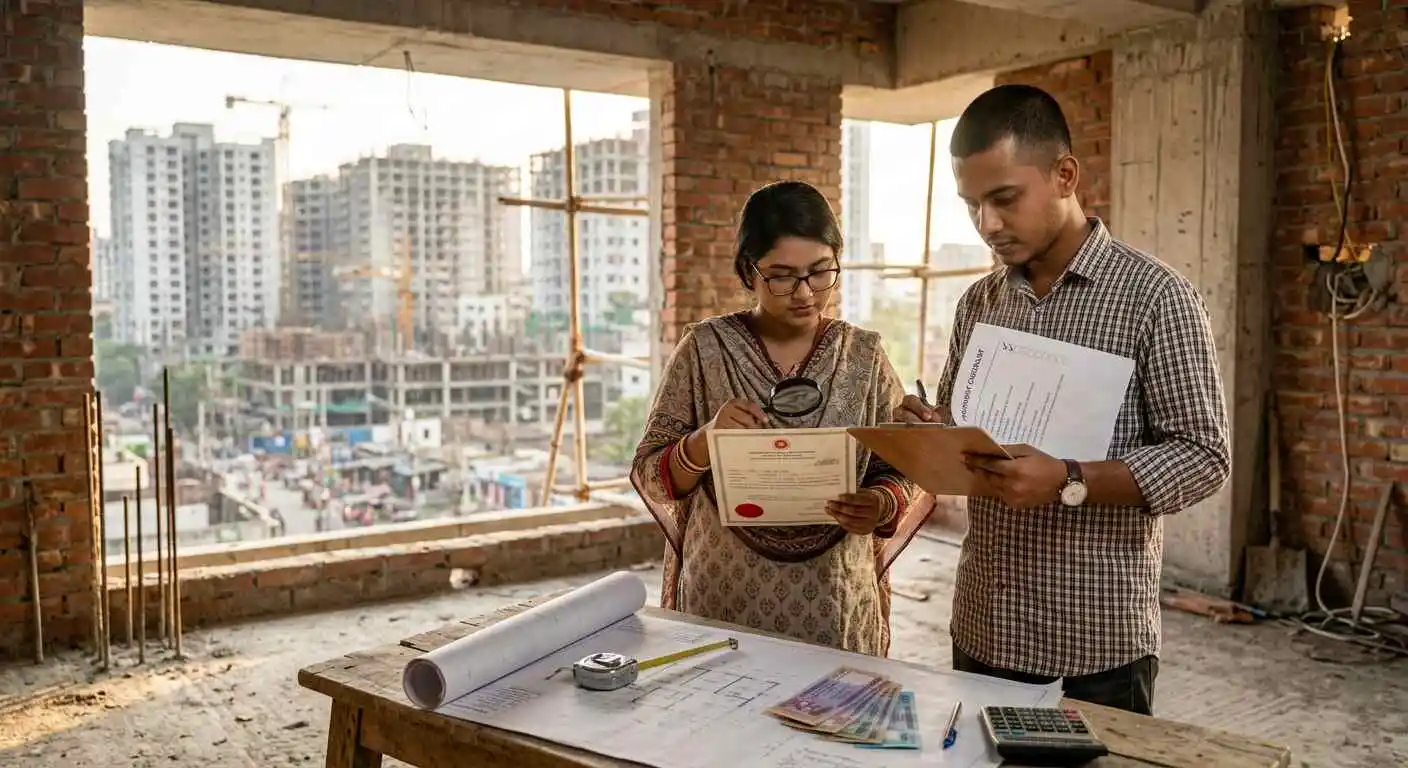
An apartment buying checklist is the single most important tool any first-time buyer needs before spending a single taka on a flat in Dhaka. Our checklist covers verifying legal titles, reading structural engineering reports, calculating your true total cost including stamp duty and VAT, physically inspecting the unit, assessing the neighborhood, and vetting the developer's delivery record. Working with a reputable Real Estate Company in Dhaka, such as PDL Real Estate, mitigates many of these risks upfront, but every buyer should still conduct these checks independently. If you are buying your first apartment in Dhaka, this checklist is your complete reference.
Legal "No-Go" Red Flags: Verifying Authenticity Before the Deposit
The legal verification phase is the most pressing step on any apartment-buying checklist. Title fraud, unregistered agreements, and mortgaged land are the three most common ways first-time buyers in Dhaka lose money before construction even begins. Every check in this section must be completed and documented before you pay any booking deposit to any developer.
Authenticating Land Titles
Verifying the original deed and tracing ownership through the CS, SA, RS, and City Survey Khatians is the foundation of any sound flat-buying process that Dhaka buyers rely on.
Request certified copies of all Khatians from the AC Land Office and confirm that the Dag number across all generations of documents matches.
A break in the chain at any point is a legal red flag that requires a property lawyer to resolve before you proceed. The original deed must be verified physically, not through photocopies alone.
Mutation (Namjari) Verification
Mutation confirms that the land is officially registered in the name of the current owner or developer at the AC Land office.
Without a current mutation certificate matching the developer's legal entity name, the developer cannot legally transfer the property to you at registration.
Request the latest certified mutation certificate and verify it against the developer's trade license and company registration documents.
Mismatched names between the mutation and the registered company name are one of the most common avoidable disputes in Dhaka apartment transactions.
RAJUK Plan and Occupancy Matching
The RAJUK-approved building plan must physically match what you are being sold. Request the original approved drawing and compare the approved number of floors, unit layout, and setback distances against the actual construction on site.
If the building has more floors than what RAJUK approved, the extra floors are illegal and can be demolished at any point.
An Occupancy Certificate, issued after construction, confirms the building was built in compliance with the approved plan. Always ask for both documents.
The Mortgaged Land Trap
Many developers in Dhaka finance land acquisition through bank loans, using the land itself as collateral.
If that mortgage is not discharged before you register your flat, the bank holds a prior legal claim that supersedes your ownership.
Request a Non-Encumbrance Certificate (NEC) from the Sub-Registry Office covering the last 25 years. The NEC will show any active mortgage, legal claim, or charge registered against the land.
Never pay a booking deposit until you see a clear NEC or a formal bank No-Objection Certificate confirming the mortgage has been discharged.
Baina Nama (Pre-Sale Agreement)
The Baina Nama is your formal pre-sale agreement with the developer, and it must be registered at the Sub-Registrar's office to be legally enforceable.
An unregistered Baina Nama gives a developer the legal space to sell the same unit to a second buyer.
The registered agreement must specify the exact flat number, floor level, size, payment schedule, handover date, and penalty clauses for delays.
Never rely on a private stamped agreement alone. Registration is the only legal way to protect your booking in Bangladesh.
Technical Engineering and Structural Survival Kits
Structural safety is the area most first-time buyers skip entirely on their apartment-buying checklist, and it is the one that carries the highest long-term physical and financial risks. Bangladesh sits in a moderate-to-high seismic zone, and buildings not designed to the correct code can fail even during a minor earthquake. The four checks below are non-negotiable for any buyer prioritizing long-term safety.
BNBC Earthquake Compliance
The Bangladesh National Building Code (BNBC) sets the minimum seismic design requirements for all buildings across the country.
Ask the developer to provide the structural design certificate, signed by a licensed structural engineer, confirming that the building meets BNBC seismic zone requirements for Dhaka.
Buildings designed before the 2006 BNBC update or without a certified structural engineer's stamp carry significant earthquake risk. Reject any building where this certificate cannot be produced in writing.
Soil Test and Foundation Specs
The soil investigation report determines how deep the piles must go and what foundation type is appropriate for the specific plot.
In Dhaka, soil bearing capacity varies enormously across neighborhoods, with low-lying areas in Aftabnagar and parts of Keraniganj requiring significantly deeper pile foundations.
Ask for the original soil test report from a certified geotechnical lab and confirm that the pile depth mentioned in the structural design matches the soil report's recommendation. A foundation built shallower than the soil report requires is a structural time bomb.
The "Wall Tapping" Test
This is a practical, immediate quality check that any buyer can perform during the site visit without technical equipment.
Knock firmly on different sections of the walls with your knuckle or a small tool. A solid, dense sound indicates properly filled masonry.
A hollow or reverberating sound indicates air pockets in the brickwork, insufficient mortar coverage, or plaster applied over an empty cavity.
These hollow spots are among the mistakes to avoid when buying a flat, which buyers discover only after moving in, when cracks begin to appear during the first monsoon season.
Concrete and Steel Testing Logs
Ask the developer to show the RCC (Reinforced Cement Concrete) test logs maintained during construction.
These logs document the compressive strength results of concrete cube tests taken at regular intervals during the pour of every slab and column.
The minimum acceptable compressive strength for residential construction in Bangladesh is 3,000 psi for columns and 2,500 psi for slabs.
A developer unwilling to share these records has likely not maintained them, which itself is a serious quality signal worth walking away from.
The "True" Cost: Granular Budgeting Beyond the Per-Square-Foot Rate
One of the most consistently underestimated items on any apartment buying checklist is the true total cost of purchase. The per-square-foot price you see in an advertisement is only the starting point. First-time buyers in Dhaka often find that the final bill is 18% to 22% above the listed price once registration charges, hidden utility fees, and deposits are included. Budget each item below before confirming affordability.
Registration, Stamp Duty, and VAT
As part of your first-time homebuyer guide to budgeting in Bangladesh, you must account for the full cost of registration.
For a typical Dhaka apartment, total registration-side costs including stamp duty (1.5%), registration fee (1%), local government tax (2%), and VAT (2% for flats below 1,600 sq ft or 4.5% above) add up to 10% to 12.5% of the deed value before AIT is included.
On a BDT 70,00,000 flat, that means an additional BDT 7,00,000 to BDT 8,75,000 in government charges alone. Plan for this before signing anything.
The "Carpet Area" vs. "Built-Up" Math
The apartment buying checklist must include a clear calculation of what you are actually paying per usable square foot.
Developers in Dhaka quote prices based on the "super built-up" or "built-up" area, which includes shared spaces such as corridors, stairwells, and lobby areas.
The carpet area (the actual livable floor space inside your walls) is typically 70% to 80% of the built-up figure.
A 1,500 sq ft apartment may have only 1,050 to 1,200 sq ft of actual usable space. Always calculate the effective price per square foot of carpet area before comparing across developers.
Hidden Utility and Parking Charges
Understanding that buying an apartment in Dhaka means knowing what is not listed in the brochure.
Utility connection fees for DESCO electricity, WASA water, and gas lines can add BDT 1,50,000 to BDT 3,00,000 per unit.
Car parking is frequently sold separately at BDT 5,00,000 to BDT 15,00,000 per slot in premium Dhaka locations.
Generator backup per unit, common area maintenance deposits, and security deposits are additional items that are commonly disclosed only at the time of agreement signing. Request a full cost summary in writing before comparing any two projects.
Maintenance Deposit Funds
Many developers collect a maintenance deposit of BDT 50,000 to BDT 2,00,000 at handover to fund the first 12 to 24 months of building management.
Confirm whether this deposit is refundable, how it is held, and whether a formal maintenance company has been contracted to manage the building.
Buildings without a formal post-handover management structure deteriorate rapidly in Dhaka's climate, losing value within 5 years of completion. Ask specifically about the post-handover maintenance plan before signing.
The Professional Walkthrough: Physical Inspection Hacks
Every comprehensive apartment-buying checklist includes a structured physical inspection of the unit before the handover payment is made. Any buyer can perform these four tests without professional equipment and will reveal the most common quality deficiencies in Dhaka apartment construction. Carry a flashlight, a phone charger, and a bottle of water to every inspection visit.
The Simultaneous Water Pressure Test
Turn on every tap, the shower, and flush every toilet in the apartment at the same time. Adequate water pressure under simultaneous use confirms that the plumbing system was designed with the correct pipe diameter and that the overhead tank capacity is sufficient.
A significant pressure drop when multiple fixtures are in use means the plumbing was designed for lower occupancy loads or was installed with undersized pipes. This defect is expensive to fix after handover and impossible to identify without the simultaneous test.
Window and Door Seal Integrity
Open and close every window and door fully, and check for daylight gaps around the frame when the door or window is shut.
Hold a lit lighter or candle near the frame edges and watch for flickering, which confirms air is passing through the seal.
Poor window seals in Dhaka allow monsoon rain to penetrate, leading to wall dampness, paint peeling, and mold within the first rainy season.
Gaps in door frames also indicate settling or poor installation that will worsen over time as the building ages.
Electrical Load and Point Testing
Plug a high-wattage device, such as a hair dryer or electric kettle, into every electrical point in the apartment to confirm that each socket is live and properly earthed.
Check the main circuit breaker panel to confirm that the number of circuits matches the number of rooms and that each circuit is clearly labeled.
In Dhaka apartment construction, common defects include dead sockets, reversed polarity, and missing earth connections, all of which are invisible without active testing and pose a fire or shock risk after occupancy.
Generator and Lift Load Realities
Ask the developer specifically which loads are covered by the backup generator. Many buildings in Dhaka provide generator backup only for common areas and a single light point per unit, not for air conditioning or kitchen appliances.
Confirm the generator's KVA rating and the number of units it can serve simultaneously. For the lift, ask for the maintenance contract and the most recent safety inspection certificate.
A lift without a current safety certificate is a liability that the residents' association will inherit from day one of occupancy.
Neighborhood Reconnaissance: The "Lifestyle Index" Check
Location is where apartment appreciation in Dhaka is ultimately determined, and it is the one item on your apartment buying checklist that cannot be fixed after purchase. The four checks below give you a structured way to evaluate a neighborhood's liveability and long-term investment quality before you commit.
The Rainy Season Inspection
Visiting the project site during or immediately after heavy rainfall is the most revealing single visit you will make in the entire flat-buying process followed by Dhaka buyers.
Observe whether the access roads flood, how quickly water drains from the ground floor perimeter, and whether the basement or parking level shows any water ingress.
Dhaka neighborhoods built on low-lying land, such as parts of Rayer Bazar, Jatrabari, and certain sections of Demra, experience seasonal flooding that directly reduces rental yield and resale value.
Noise Level and Privacy Assessment
Visit the specific floor and unit you intend to purchase at three different times which are morning, midday, and evening.
Noise from main roads, mosques, school playgrounds, and commercial kitchens behaves differently across these windows.
Evaluate whether the project offers a single-unit-per-floor design, which dramatically improves privacy versus two- or three-unit-per-floor layouts.
For Dhaka real estate investment purposes, single-unit-per-floor buildings consistently command higher rental premiums and resale prices than standard multi-unit floors in the same area.
Security and Neighbor Profile
Ask the developer how many security staff are stationed 24 hours a day and where the CCTV cameras are positioned.
Speak with at least two or three existing residents in any occupied units and ask directly about their experiences with management responsiveness, security incidents, and the community atmosphere.
Existing residents will tell you things the sales team will not. The quality of the neighbor community in a Dhaka apartment building has a measurable effect on both daily liveability and the building's long-term maintenance standards.
Infrastructure Connectivity
Among the best areas for real estate investment in Dhaka in 2026 are those with direct or near-direct access to the MRT Line 6 (Uttara to Motijheel), the proposed MRT Line 5, or the Dhaka Elevated Expressway.
Properties within a 10-minute walk of an MRT station have demonstrated 15% to 25% higher rental yields and faster resale cycles in markets across South and Southeast Asia.
Projects like those in Jolshiri Abashon and Aftabnagar benefit from closeness to the expressway network, which is a factor worth weighing alongside price per square foot.
Developer Due Diligence: Vetting History vs. Marketing
The final section of any thorough apartment buying checklist is a structured investigation of the developer's delivery record. Marketing materials, show apartments, and sales presentations are designed to create confidence. Your independent research on completed projects is the only objective evidence of what the developer actually delivers when the brochure is set aside.
Past Project Site Visits
One of the most powerful flat-buying tips any experienced Dhaka buyer will give you is to visit a building that the developer completed at least five years ago and evaluate how the finishes, structure, and common areas have aged.
Look specifically at the lift lobby condition, the exterior facade, stairwell paint, and water tank maintenance.
Developers like PDL Real Estate, with 40 years of completed projects across Dhaka and Narayanganj, offer buyers a long track record of physical projects that newer market entrants simply cannot match. Aging gracefully is the true measure of construction quality.
Handover Delay Records
Search for the developer's name in REHAB (Real Estate and Housing Association of Bangladesh) records and in public Facebook groups for apartment buyers.
Documented patterns of delays beyond 12 months, unresolved buyer complaints, or litigation with previous customers are disqualifying signals for any serious buyer.
The mortgage tips for first-time buyers who are financing a purchase with a bank loan, your EMI obligation begins at disbursement, not at possession, so a delayed handover directly costs you money in double payments.
After-Sales Service Framework
Ask the developer specifically whether they operate a dedicated post-handover management team for the first one to two years after occupancy.
This team handles defect corrections, common area management, and utility coordination during the period when buildings are most vulnerable to quality issues surfacing.
Developers with a formal after-sales service structure, a named maintenance team, and documented response-time commitments signal organizational maturity that protects your investment long after the sale is complete. This is a key factor in how Dhaka real estate investment delivers its long-term return.
Frequently Asked Questions on Apartment Buying Checklist for First-Time Buyers in Dhaka
What are the 5 mandatory legal documents required to buy a flat in Dhaka?
CS/RS Khatian, registered deed chain (Bia Dolil), mutation certificate, RAJUK-approved plan, and Non-Encumbrance Certificate.
Can I safely book an apartment if the building doesn't have RAJUK approval?
No. Without RAJUK approval, the building is illegal and can be demolished, leaving you with no legal recourse for recovery.
How much is the total registration cost for a flat in Bangladesh in 2026?
Total registration costs range from 10% to 12.5% of the declared deed value, excluding AIT and miscellaneous charges.
What is the difference between carpet area and super built-up area in Dhaka?
Carpet area is usable living space. Super built-up includes shared corridors and lobbies, typically 20% to 30% larger than carpet area.
What happens if a developer delays the apartment handover past the agreed date?
You can claim compensation if the registered Baina Nama includes a penalty clause for delays beyond the agreed handover date.
Is it better to buy a ready apartment or an under-construction flat in Dhaka?
Ready apartments carry less delivery risk. Under-construction flats offer lower prices but require strong legal agreements and developer vetting.
How can I check if the land for an apartment project is mortgaged to a bank?
Request a Non-Encumbrance Certificate (NEC) from the Sub-Registry Office. It reveals all active charges registered against the land.
What is a "Baina Nama" and why must it be registered?
It is the pre-sale agreement. Registration makes it legally enforceable and prevents the developer from selling your unit to another buyer.
Do I need a "Mutation Certificate" before I can register my new flat?
The developer needs a valid mutation in their name. Buyers then complete their own mutation after receiving the registered deed.
How do I verify whether a building in Dhaka is earthquake-resistant under the BNBC?
Request the structural design certificate signed by a licensed engineer confirming compliance with BNBC seismic zone requirements for Dhaka.